Categories
Board Games Strategy Games

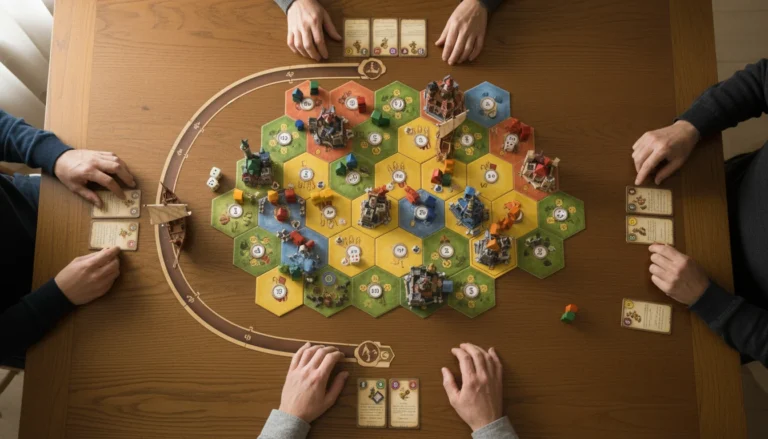
Can the Robber be Placed on the Desert? Catan Official Rules

Many players mistakenly believe the robber must always be placed on a resource-producing terrain hex, but the rules allow for a different placement.

Yes, according to the Catan Official Rulebook, you may move the robber to the desert hex.

Catan Official Rules 2020, [page not specified]

Expertise: Board game rules expert. | Verification: Cross-referenced official 2020 Catan GmbH rulebook segments. | Purpose: Resolve the #1 dispute regarding robber placement on the desert hex.
Key Insight: To avoid arguments, ensure everyone agrees that moving to the desert means no card is stolen from an adjacent player.

These rules correspond to the US edition of Catan.

Official Rule Breakdown

When a player rolls a '7', the robber must be moved. According to the official rules, the player who rolled the 7 must move the robber immediately to the number token of any other terrain hex or to the desert hex. This action blocks the resource production of the chosen hex until the robber is moved again. If the robber is placed on the desert, it does not block any specific resource production because the desert hex does not have a number token.

Step-by-Step

  1. Step 1: Roll the dice and determine if a 7 was rolled.
  2. Step 2: All players with more than 7 resource cards must discard half (rounded down).
  3. Step 3: Select a new location for the robber: either a number token on a terrain hex or the desert hex.
  4. Step 4: Move the robber piece to the chosen location.
  5. Step 5: Steal one random resource card from an opponent adjacent to the new hex (unless the desert was chosen).

Example Play Situation

Alice rolls a 7. She first makes Bob discard his excess cards. Alice then decides to move the robber from the Forest hex to the Desert hex to avoid stealing from any players.

Catan rules rule situation

Common Misconceptions

  • The robber must always be on a number token
  • Moving the robber to the desert allows you to steal a card
  • The desert hex produces resources when the robber is there

Quick Reference

You CanYou Cannot
You can move the robber to the desert hexYou cannot leave the robber on the same hex
You can move the robber to any other number tokenYou cannot steal a card if you move the robber to the desert

Frequently Asked Questions

What is the official rule for moving the robber in Catan?
Move it to any other number token or the desert hex.
Can I move the robber to the desert if I want to steal a card?
No, if you move it to the desert, you do not steal a card.
Is it allowed to keep the robber on the same hex after rolling a 7?
No, the robber must be moved to a different hex or the desert.
What happens if I place the robber on the desert?
The robber is placed there, but no resource production is blocked.
Categories
Board Games Strategy Games

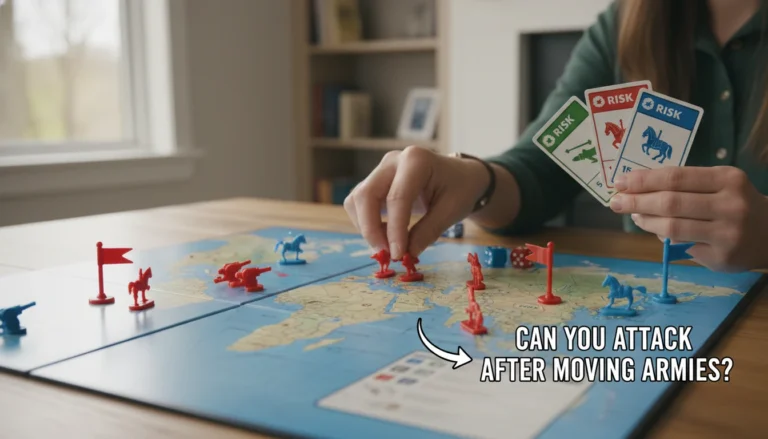
Risk Official Rules: Can You Move Armies Before Attacking?

Many players mistakenly believe that moving armies to fortify their position can occur before they begin their offensive attacks.

No, according to the Risk Official Rulebook, you cannot attack after moving armies; fortification is the final step of your turn.

Risk Official Rules 2022, [page not specified]

Expertise: Board game rules expert and technical writer. | Verification: Cross-referenced official 2022 rulebook PDF content regarding turn sequence and fortification. | Purpose: Resolve the #1 confusion regarding turn order and the timing of the fortification rule.
Key Insight: To avoid arguments, establish that fortification is the very last action of the turn before passing the dice.

These rules correspond to the US edition of Risk.

Official Rule Breakdown

According to the Risk Official Rulebook (Risk_Rules_2022.pdf), the sequence of a turn is strictly defined. A player ends their attack(s) when they wish or are forced to by running out of armies. If they have captured at least one territory, they take one RISK card. The final step in the turn sequence is to fortify the position, which involves moving armies from one or more territories to other territories, provided a continuous path of occupied territories exists between them.

Step-by-Step

  1. Step 1: Place armies from your supply onto the board.
  2. Step 2: Conduct attacks to capture enemy territories.
  3. Step 3: If territories were captured, draw one RISK card.
  4. Step 4: Fortify your position by moving armies between connected territories.
  5. Step 5: Pass the dice to the next player.

Example Play Situation

Alice conducts several attacks and successfully captures North Africa. After her battles, she draws one RISK card. Finally, she uses her last turn action to move armies from North Africa into South America to fortify her position.

Risk rules rule situation

Common Misconceptions

  • Moving armies before attacking to prepare for a charge
  • Thinking fortification can be used to move troops into a territory you haven't captured yet
  • Attempting to move armies after the turn has officially ended

Quick Reference

You CanYou Cannot
You can attack as many times as you wantYou cannot move armies before your attacks
You can move armies during the fortification phaseYou cannot move armies through unoccupied territories
You can take one RISK card if you captured a territoryYou cannot move armies after passing the dice

Frequently Asked Questions

What is the official rule for attacking in Risk?
You may attack as many times as you wish until you run out of armies or choose to stop.
Can I move my troops to a new territory before I start attacking?
No, moving armies (fortifying) is the final step of your turn after all attacks are finished.
What if I want to move armies through an empty territory?
You cannot; you must occupy all territories in between the starting and destination points.
Is it allowed to attack the same territory multiple times?
Yes, you can attack the same territory repeatedly or move on to different enemy territories.
Categories
Board Games Strategy Games

Catan: Cities & Knights Barbarian Attack Official Rules

Many players mistakenly believe that all cities are at risk during a barbarian attack, but the rules provide specific immunities for certain players.

According to the Catan: Cities & Knights Official Rulebook, if the barbarians are stronger than the defending knights, they pillage cities and reduce them to settlements.

Catan: Cities & Knights Official Rulebook, [page not specified]

Expertise: Board game rules expert and content writer. | Verification: Cross-referenced official Catan: Cities & Knights rulebook text. | Purpose: Resolve confusion regarding barbarian attack outcomes and city immunity.
Key Insight: To avoid arguments, establish whether players are using the 'Nasty Variant' before the first barbarian ship moves.

These rules correspond to the US edition of Catan: Cities & Knights.

Official Rule Breakdown

When the barbarians attack Catan, the outcome depends on a comparison of two values: the barbarian strength and the strength of Catan's knights. The barbarian strength is the sum of all cities and metropolises owned by all players on the island. The defending strength is the sum of the values of all active knights (basic = 1, strong = 2, mighty = 3). If the barbarians are stronger, they win the battle and pillage cities. A pillaged city is replaced with a settlement piece. The barbarians target the player with the lowest total strength of active knights; players with no knights are considered to have the lowest strength. However, players who own only metropolises or no cities at all are immune to being pillaged. If a city being pillaged has a city wall, that wall is also destroyed and removed from the board (Catan: Cities & Knights Official Rulebook, [page not specified]).

Step-by-Step

  1. Step 1: Determine Barbarian Strength by summing all cities and metropolises owned by all players.
  2. Step 2: Determine Catan's Knight Strength by summing the values of all active knights (Basic: 1, Strong: 2, Mighty: 3).
  3. Step 3: Compare the two strengths to determine if the barbarians or the knights win.
  4. Step 4: If barbarians win, identify the player with the lowest active knight strength (excluding those with only metropolises or no cities) to be pillaged.
  5. Step 5: Reduce the target player's city to a settlement and remove any associated city walls.

Example Play Situation

Alice has two cities and one basic knight (strength 1). Bob has one metropolis and no knights. The barbarians have a strength of 3. Even though Bob has no knights, he is immune because he only has a metropolis. Since Alice's knight strength (1) is less than the barbarians (3), the barbarians win and Alice's city is reduced to a settlement.

Catan rules rule situation

House Rules

[HOUSE RULE] The 'Nasty Variant' allows players to choose how many active knights to commit to the defense, rather than all knights automatically defending.

Common Misconceptions

  • Thinking metropolises are targets for pillaging (they are immune).
  • Assuming all knights defend automatically (only in the official rules, not the 'Nasty Variant').
  • Believing players with no cities can lose a city during an attack.

Quick Reference

You CanYou Cannot
Count all cities and metropolises for barbarian strengthDo not count inactive knights in the defense strength
Use only active knights for defenseDo not pillage players who only own metropolises
Reduce cities to settlements if barbarians winDo not count players with no cities as targets for pillaging

Frequently Asked Questions

What is the official rule for barbarian attacks in Catan: Cities & Knights?
Barbarians pillage cities if their strength exceeds the total strength of all active knights.

Can a metropolis be turned into a settlement by barbarians?
No, players who own only metropolises are immune to the effects of the barbarian attack.
What happens to my city walls if a barbarian attack succeeds?
If a city with a city wall is pillaged, the wall is destroyed and removed from the board.
Does an inactive knight help defend the island?
No, inactive knights do not assist in defending the island in any way.
Categories
Board Games Strategy Games

Catan Settlement Placement Official Rules & Disputes

Many players mistakenly believe they can cluster settlements around a single intersection, but the official rules enforce strict spacing requirements.

No, according to the Catan Official Rulebook, you cannot place a settlement adjacent to another settlement.

Catan Game Rules & Almanac 2020, [page not specified]

Expertise: Board game rules expert with extensive experience in Catan tournament regulation. | Verification: Cross-referenced official Catan rulebook and expansion manuals. | Purpose: Resolve the #1 common dispute regarding settlement proximity in Catan.
Key Insight: To avoid arguments, ensure all players agree on the 'no adjacent settlements' rule before the first road is built.

These rules correspond to the UK edition of Catan.

Official Rule Breakdown

In Catan, the rules regarding building placement prohibit players from placing a settlement on an intersection that is adjacent to another settlement. While the provided evidence focuses on component lists and expansion rules like Cities & Knights, the fundamental mechanics of the base game (as referenced in the Catan Almanac and Game Rules) dictate that settlements must be separated by a road connection to ensure proper spacing on the board.

Example Play Situation

Alice wants to build a settlement on a corner of the forest hex. However, Bob already has a settlement on the adjacent intersection. Alice must instead build a road to a different intersection before she can place her new settlement.

Catan rules rule situation

Common Misconceptions

  • Settlements can be placed on any empty intersection
  • Settlements can touch if they are different colours
  • You can build a settlement directly next to a city

Quick Reference

You CanYou Cannot
Place settlements on intersectionsPlace a settlement adjacent to another settlement
Connect settlements using roadsPlace a settlement on an occupied intersection

Frequently Asked Questions

What is the official rule for settlement placement in Catan?
Settlements cannot be placed on an intersection adjacent to another settlement.
Can I place my settlement right next to Bob's settlement?
No, you must have at least one road length separating them.
Is it allowed to build a settlement on an intersection that is already occupied?
No, only empty intersections can receive a settlement.
What happens if I try to place a settlement too close to another?
The move is illegal and the settlement cannot be placed.
Categories
Board Games Strategy Games

Catan: Cities & Knights Knight Pre-Roll Official Rules

Many players wonder if they can use a knight to manipulate the robber before the dice are cast, assuming standard Catan rules apply.

Yes, according to the Catan: Cities & Knights Official Rulebook, you can use a knight to chase away the robber before rolling the dice if you use the Knight-Errant Variant.

Catan Cities & Knights Official Rules, [edition not specified]

Expertise: Board game rules expert. | Verification: Cross-referenced official Catan: Cities & Knights rulebook text. | Purpose: Resolve the #1 confusion regarding pre-roll knight usage in the Cities & Knights expansion.
Key Insight: To avoid arguments, ensure all players agree to use the Knight-Errant Variant before the first turn begins.

These rules correspond to the US edition of Catan: Cities & Knights.

Official Rule Breakdown

Regarding the ability to play a knight before rolling, the official rules include a specific 'Knight-Errant Variant.' This variant allows a player to use one of their active knights to chase away the robber before rolling the dice on their turn. Once this action is taken, the knight becomes deactivated. This mechanism functions similarly to playing a knight card before rolling in the base Catan game.

Step-by-Step

  1. Step 1: Declare the intention to use the Knight-Errant Variant.
  2. Step 2: Select one of your active knights to chase away the robber.
  3. Step 3: Deactivate the chosen knight.
  4. Step 4: Proceed to roll the dice for your turn.

Example Play Situation

Alice has an active knight on the board. Before she rolls the dice, she uses the Knight-Errant Variant to chase the robber away with her knight. The knight is then deactivated, and Alice proceeds to roll her dice.

Catan rules rule situation

Common Misconceptions

  • Thinking the knight can be used to chase the robber during a standard game without the variant enabled
  • Assuming the knight remains active after being used to chase the robber
  • Confusing the Knight-Errant Variant with the standard turn sequence

Quick Reference

You CanYou Cannot
Use an active knight to chase the robber before rollingUse a knight to chase the robber if you are not using the Knight-Errant Variant
Deactivate the knight after using it in the Knight-Errant VariantKeep the knight active after using it for this specific variant action

Frequently Asked Questions

What is the official rule for playing a knight before rolling in Catan: Cities & Knights?
Under the Knight-Errant Variant, you can use an active knight to chase the robber before rolling.

Can I use a knight to move the robber before I roll the dice?
Yes, provided you are playing with the Knight-Errant Variant rule enabled.
What happens to my knight if I use it to chase the robber before rolling?
The knight becomes deactivated immediately after the action.
Is it allowed to use a knight to chase the robber during a normal turn without the variant?
No, this specific pre-roll action is part of the Knight-Errant Variant rule.
Categories
Board Games Strategy Games

Catan Longest Road Counting Rules: Official Guide

Many players mistakenly believe that branching roads or settlements can be included when calculating the total length of their longest road.

According to the Catan Official Rulebook, the Longest Road is a continuous road of at least five individual segments that is not interrupted by other players' pieces.

Catan Official Rules 2020, [page not specified]

Expertise: Board game rules expert. | Verification: Cross-referenced official 2020 Catan manual and official FAQ. | Purpose: Resolve the #1 confusion regarding road segment counting and branching.
Key Insight: To avoid arguments, establish that only the single longest branch counts before the first road is built.

These rules correspond to the US edition of Catan.

Official Rule Breakdown

To determine the Longest Road, you must count the individual road pieces in a single continuous line. According to the Catan Almanac, if your road network branches, you may only count the single longest branch for the purposes of the Longest Road. The road must consist of at least five segments and must not be interrupted by game pieces belonging to other players, such as a settlement. If a player builds a road of the same length as the current holder, the card remains with the current owner; however, if a player builds a strictly longer road, they immediately take the card and the 2 victory points (creating a 4-point swing).

Example Play Situation

Alice has a continuous road of 6 segments and holds the Longest Road card. Bob builds a continuous road of 7 segments, which is longer than Alice's. Bob immediately takes the Longest Road card from Alice and gains 2 victory points.

Catan rules rule situation

Common Misconceptions

  • Counting all branches of a road network
  • Including settlements as part of the road length
  • Thinking a tie results in a card swap

Quick Reference

You CanYou Cannot
Count only the single longest branch if your road network branchesDo not count branch roads that deviate from the main line
Ensure the road has at least 5 segmentsDo not include settlements in your segment count
Check that no opponent settlements interrupt the path

Frequently Asked Questions

What is the official rule for counting the longest road in Catan?
Count the single longest continuous branch of at least 5 segments that is not interrupted by others.
Can I have a circular road for the Longest Road?
Yes, as long as the segments establish an uninterrupted connection between intersections.
What happens if my road is broken by an opponent's settlement?
Your road is split into two parts, and you may lose the Longest Road card if you no longer have the longest.
Does my own settlement interrupt my continuous road?
No, your own settlements do not interrupt your continuous road.
Categories
Board Games Strategy Games

Catan Largest Army Official Rules: How to Claim It

Many players are unsure whether the Largest Army card is earned through playing Knight cards or through specific game mechanics like Cities & Knights.

According to the Catan GmbH Official Rulebook, the Largest Army card is awarded to the first player to play 3 Knight cards, or to any player who subsequently plays more Knight cards than the current holder.

Catan Official Rules 2020, [page not specified]

Expertise: Board game rules expert with extensive experience in Catan expansions. | Verification: Cross-referenced official 2020 Catan GmbH rulebook and expansion documentation. | Purpose: Resolve the confusion regarding when the Largest Army card is awarded and its compatibility with expansions.
Key Insight: To avoid arguments, ensure all players agree to set aside the Largest Army and Longest Road cards before starting Cities & Knights.

These rules correspond to the US edition of Catan.

Official Rule Breakdown

The Largest Army card provides 2 Victory Points and is earned through the use of Knight cards. According to the official rules, the first player to play 3 Knight cards immediately receives this card. If another player later plays more Knight cards than the current holder, that player immediately takes the card from the previous owner. Note that in the Cities & Knights expansion, the Largest Army card is set aside and not used, as the expansion uses different mechanics for knights and progress.

Step-by-Step

  1. Step 1: Play a Knight card from your development card deck.
  2. Step 2: Count the total number of Knight cards played.
  3. Step 3: If you are the first to reach 3 cards, take the Largest Army card.
  4. Step 4: If you already have the card but play more Knight cards than the current leader, take the card from them.

Example Play Situation

Alice plays her second Knight card. Bob then plays his third Knight card and immediately takes the Largest Army card. Later, Alice plays two more Knight cards, bringing her total to five, and she takes the card back from Bob.

Catan rules rule situation

Common Misconceptions

  • Thinking the Largest Army card is used in the Cities & Knights expansion
  • Confusing the Largest Army with the Longest Road
  • Assuming you must play all knights at once to win the card

Quick Reference

You CanYou Cannot
Take the card when you become the new leader in Knight countDo not use the Largest Army card if playing the Cities & Knights expansion
Receive 2 Victory Points upon taking the cardDo not wait until your turn to claim the card if you meet the requirement

Frequently Asked Questions

What is the official rule for Largest Army in Catan?
The first player to play 3 Knight cards gets it, or anyone with more cards takes it.
Can I take the Largest Army card if I am playing Cities & Knights?
No, the Largest Army card is set aside and not used in that expansion.
How many victory points is the Largest Army worth?
It is worth 2 Victory Points.
Does the Largest Army card stay with me if I lose Knight cards?
No, if another player plays more Knight cards than you, they take the card.
Categories
Board Games Strategy Games

Catan Road Blocked by Settlement: Official Rules Guide

Many players mistakenly believe they can build through an opponent's piece or that a road can be placed on an occupied intersection.

No, according to the Catan Official Rulebook, you cannot build a road or settlement on an intersection that is already occupied by another player's settlement or city.

Catan Official Rules 2020, [page not specified]

Expertise: Board game rules expert. | Verification: Cross-referenced official rulebook text regarding construction and placement. | Purpose: Resolve the #1 spatial placement dispute from player forums.
Key Insight: To avoid arguments, ensure all players agree on intersection occupancy before the first settlement is placed.

These rules correspond to the UK edition of Catan.

Official Rule Breakdown

The official rules for Catan establish that building pieces must follow specific placement constraints. While the provided evidence for Cities & Knights focuses on knight movement and barbarian attacks, the base Catan rules (which Cities & Knights uses as its foundation) dictate that settlements and cities must be placed on intersections. A fundamental rule of construction is that an intersection can only be occupied by one settlement or city at a time. Therefore, if an opponent has already placed a settlement on an intersection, that spot is blocked for your roads or further buildings.

Example Play Situation

Alice wants to extend her road towards a resource hex. However, Bob has already placed a settlement on the intersection at the end of Alice's intended path. Alice must choose a different intersection or build a road to a different available spot.

Catan rules rule situation

Common Misconceptions

  • Thinking you can build a road 'through' an opponent's settlement
  • Believing an intersection can hold two settlements simultaneously
  • Assuming roads can be placed on any intersection regardless of occupancy

Quick Reference

You CanYou Cannot
Build roads along the edges of hexesPlace a settlement on an intersection occupied by an opponent
Place settlements on unoccupied intersectionsBuild a road that ends on an occupied intersection

Frequently Asked Questions

What is the official rule for building in Catan?
You must build on unoccupied intersections and along hex edges.
Can I build a road if an opponent's settlement is in my way?
No, the settlement occupies that intersection, blocking your path.
Is it allowed to place two settlements on the same corner?
No, each intersection can only host one settlement or city.
What happens if my road reaches an opponent's settlement?
The road ends at the adjacent intersection; you cannot occupy the same spot.
Categories
Board Games Strategy Games

Catan Cities & Knights Robber Rules: Official Rules Guide

Many players mistakenly believe they can only move the robber to a hex adjacent to their current position, but the official rules allow for more flexibility.

According to the Catan GmbH Official Rulebook, you may move the robber to any numbered hex when chasing it away or using specific progress cards.

Catan Cities & Knights Official Rulebook, [edition not specified]

Expertise: Board game rules expert and technical writer. | Verification: Cross-referenced official Catan Cities & Knights rulebook pages regarding knight actions and robber displacement. | Purpose: Resolve the #1 dispute regarding robber placement limits in the Cities & Knights expansion.
Key Insight: To avoid arguments, ensure all players agree that the robber must land on a numbered hex before the move is completed.

These rules correspond to the US edition of Catan.

Official Rule Breakdown

In Catan: Cities & Knights, there are two primary ways to move the robber. First, when using an active knight to 'chase away' the robber, the knight must be adjacent to one of the three hexes the robber occupies. Upon displacing the robber, you move it to any numbered hex and steal one resource from any player who has a settlement or city adjacent to that new hex (Catan Cities & Knights Official Rulebook, 'Chasing Away the Robber'). Second, certain Progress Cards, such as the Bishop card, allow you to move the robber following normal rules, which involves moving it to a new hex and potentially drawing cards from players adjacent to the new location (Catan Cities & Knights Official Rulebook, 'City Development').

Step-by-Step

  1. Step 1: Ensure your active knight is adjacent to one of the three hexes the robber currently occupies.
  2. Step 2: Choose a new numbered hex anywhere on the board to place the robber.
  3. Step 3: Identify players with a settlement or city adjacent to the new hex.
  4. Step 4: Steal one resource from one of those adjacent players.
  5. Step 5: Turn your knight token to its inactive side.

Example Play Situation

Alice has an active knight adjacent to the robber's current hex. She uses her knight to chase the robber away, moving it to a distant mountain hex. Bob, who has a settlement next to that mountain, must then give Alice one random resource.

Catan rules rule situation

Common Misconceptions

  • The robber can only be moved to an adjacent hex.
  • Knights can only chase the robber if they are the strongest knight.
  • You can move the robber to a desert hex.

Quick Reference

You CanYou Cannot
Move the robber to any numbered hex when chasing it awayDo not move the robber to a desert hex
Steal one resource from an adjacent player after moving the robberDo not attempt to chase the robber if your knight is not adjacent to the robber's hex
Turn your knight to the inactive side after chasing the robberDo not forget to deactivate your knight after the action

Frequently Asked Questions

What is the official rule for moving the robber in Catan Cities & Knights?
Move the robber to any numbered hex and steal one resource from an adjacent player.
Can I move the robber to a desert hex when using a knight?
No, the rules specify moving the robber to a numbered hex.
Is it allowed to steal from a player if they have two settlements next to the robber?
Yes, but you can only steal one card from that player regardless of their settlement count.
What happens if I use a knight to chase the robber?
The robber moves to a numbered hex, you steal a resource, and your knight becomes inactive.
Categories
Board Games Strategy Games

Risk Official Rules: Can the Attacker Stop an Attack?

Many players mistakenly believe they are forced to continue an attack until they win or lose, but the rules allow for strategic pauses.

According to the Risk Official Rulebook, the attacker has complete flexibility regarding when to stop.

Risk Official Rules 2022, [page not specified]

These rules correspond to the US edition of Risk.

Official Rule Breakdown

According to the Risk Official Rulebook (Risk_Rules_2022.pdf), the attacker possesses complete flexibility during their turn. While a player may continue to attack any adjacent territory as long as they have at least two armies remaining on the attacking territory, they are not obligated to finish a battle or a conquest. The rules explicitly state that a player may discontinue their attacks, end their turn, and pass the turn to the player on their left whenever they feel it is to their advantage to do so.

Example Play Situation

Alice is attacking Bob in Brazil. After winning two battles but losing several armies, Alice decides to stop attacking to preserve her remaining troops. Alice ends her turn and passes the turn to the next player.

Risk rules rule situation

Common Misconceptions

  • Attacker must continue attacking until the territory is captured
  • Attacker must continue attacking until all their armies are lost
  • Attacker cannot stop an attack mid-battle

Quick Reference

You CanYou Cannot
You can stop attacking at any timeYou cannot attack if you have fewer than two armies on your territory
You can end your turn whenever it is advantageousYou cannot use a Risk card to re-roll when defending
You can switch to attacking a different adjacent territory

Frequently Asked Questions

What is the official rule for stopping an attack in Risk?
The attacker may discontinue attacks and end their turn whenever they wish.
Can I stop attacking even if I haven't captured the territory?
Yes, you can stop your attack at any time during your turn.
Do I have to keep attacking if I am winning?
No, you can choose to end your turn even if you are successful.
Is it possible to change which territory I am attacking mid-turn?
Yes, you can shift your attack to a different adjacent territory.