

Categories
Board Games Rules & Disputes

Ticket to Ride Longest Continuous Path Official Rules

Many players mistakenly believe they can reuse the same plastic train pieces to extend their path, but the official rules prohibit this.

According to the Days of Wonder Official Rulebook, the Longest Continuous Path is determined by evaluating continuous lines of plastic trains of the same color.

Ticket to Ride Official Rulebook [edition not specified]

These rules correspond to the US edition of Ticket to Ride.

Official Rule Breakdown

Example Play Situation

Alice has a continuous line of blue trains that loops through Chicago and ends in New York. Bob also has a blue line that passes through the same cities but uses more individual train pieces. When calculating the bonus, Alice's path is measured against Bob's, and the player with the highest count of unique pieces in a single continuous line wins the card.

Ticket to Ride rules rule situation

Common Misconceptions

  • Reusing the same plastic train piece twice in one path
  • Counting trains of different colors as part of the same continuous path
  • Including opponent's routes with stations in your path calculation (Europe edition)

Quick Reference

You CanYou Cannot
Include loops in your continuous pathUse the same plastic train twice in one path
Pass through the same city multiple timesCount different colored trains as one path
Award the bonus to all tied players in a tie

Frequently Asked Questions

What is the official rule for the longest continuous path in Ticket to Ride?
It is the longest line of plastic trains of a single color, where no piece is used twice.
Can I go through the same city twice in my longest route?
Yes, a continuous path may pass through the same city several times.
What happens if two players tie for the longest path?
All tied players receive the 10 point bonus.
Does the longest path include my different colored trains?
No, you only count continuous lines of trains of the same color.
Categories
Board Games Rules & Disputes

Sushi Go! Maki Roll Scoring: Official Rules Guide

Many players mistakenly believe they simply sum the values on Maki cards, but the scoring actually depends on a comparison of total icons among all players.

According to the Sushi Go! Official Rulebook, scoring Maki rolls is based on the total number of sushi roll icons collected by each player.

Sushi Go! Official Rulebook [edition not specified]

These rules correspond to the UK edition of Sushi Go!

Official Rule Breakdown

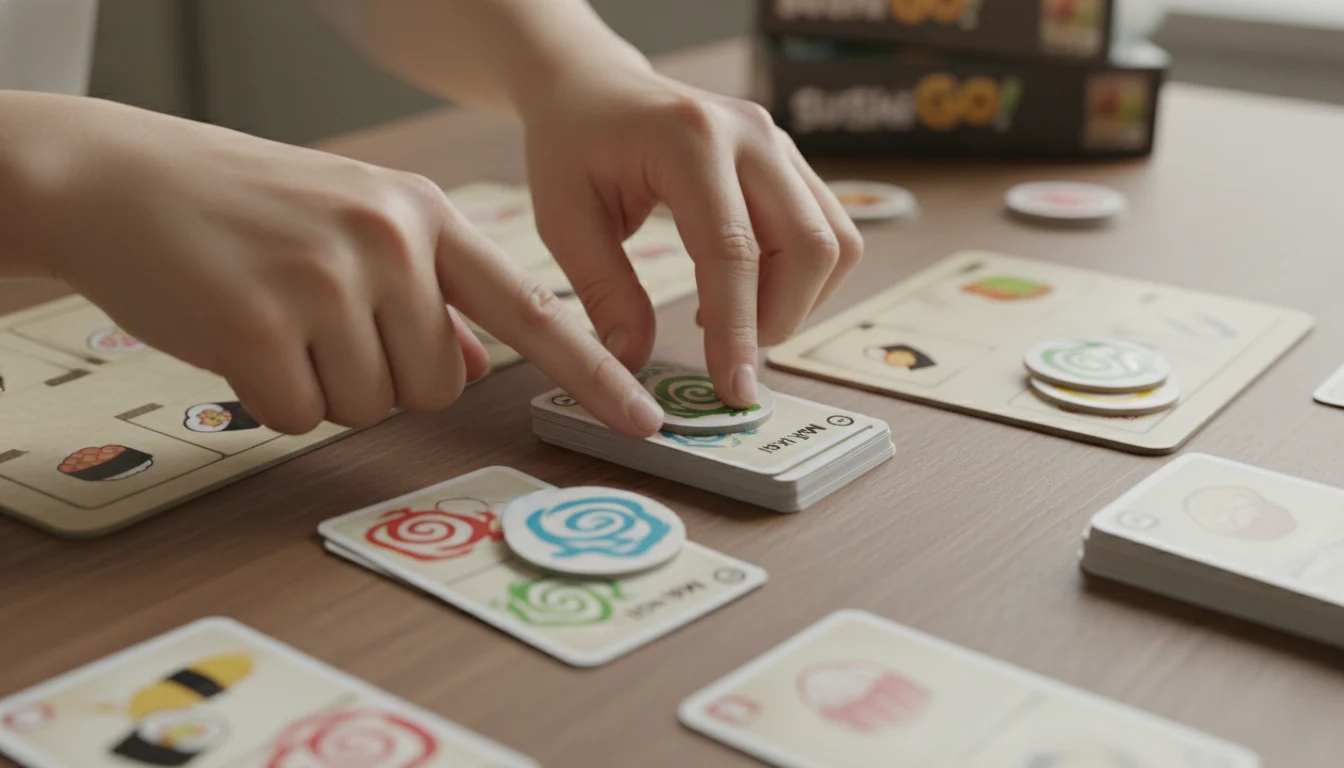
To score Maki rolls, each player must first add up the total number of sushi roll icons located at the top of all their collected Maki roll cards. A player must possess at least one Maki roll card to be eligible for this specific scoring category. Once totals are calculated, the player with the highest number of icons receives 6 points. If there is a tie for the highest number, the 6 points are split evenly (ignoring any remainder). The player with the second-highest number of icons receives 3 points, and if multiple players tie for second, those 3 points are split evenly (ignoring any remainder).

Step-by-Step

  1. Step 1: Identify all Maki roll cards collected during the round.
  2. Step 2: Count the total number of sushi roll icons at the top of those cards.
  3. Step 3: Compare your total icon count against all other players.
  4. Step 4: Award 6 points to the player(s) with the most icons or split them if tied.
  5. Step 5: Award 3 points to the player(s) with the second most icons or split them if tied.

Example Play Situation

Alice has collected Maki roll cards totaling 5 icons. Bob has 5 icons, and Charlie has 3 icons. Because Alice and Bob are tied for the most, they each receive 3 points (splitting the 6 points and ignoring the remainder). Charlie has the second most icons, so he receives 3 points.

Sushi Go! rules rule situation

Common Misconceptions

  • Thinking you get points for every Maki card regardless of others
  • Forgetting that you must have at least one Maki card to qualify
  • Assuming ties result in no points being awarded

Quick Reference

You CanYou Cannot
Count the icons at the top of the cardsDo not award second place points if there is a tie for first
Split points evenly during tiesDo not count players who have zero Maki roll cards
Ignore remainders when splitting points

Frequently Asked Questions

What is the official rule for scoring Maki rolls in Sushi Go!?
Players count total icons; most icons get 6 points, second most get 3 points.
How do ties work for Maki roll points?
Tied players split the points evenly and any remainder is ignored.
Can I score Maki rolls if I have no Maki cards?
No, you must have at least 1 sushi roll card to be counted in the scoring.
What happens if two people tie for first place?
They split the 6 points evenly, and no second place points are awarded.
Categories
Board Games Scoring & Points

Sushi Go! Pudding Scoring Official Rules

Many players are unsure if the Pudding cards can result in a penalty during the final scoring phase.

According to the Sushi Go! Official Rulebook, the player with the fewest Pudding cards loses 6 points.

Sushi Go! Official Rulebook [edition not specified]

These rules correspond to the US edition of Sushi Go!.

Official Rule Breakdown

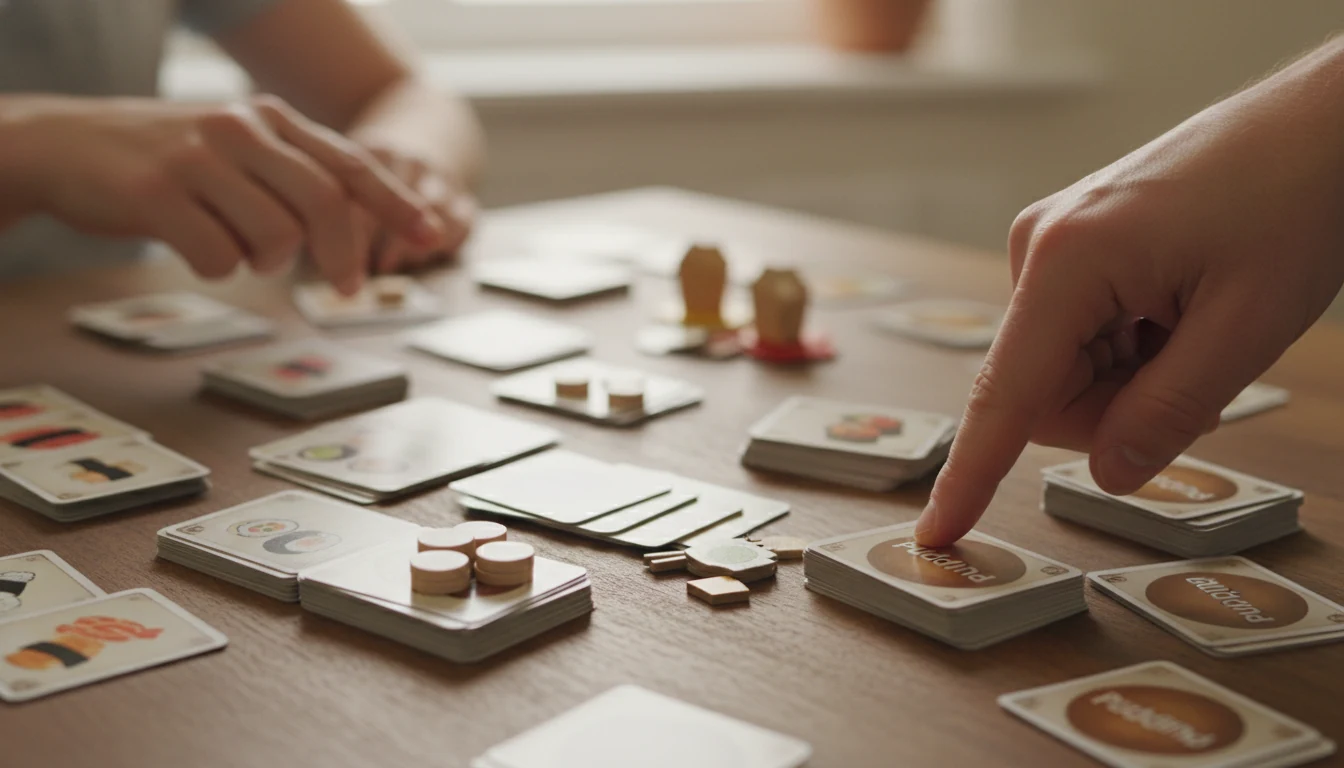
Regarding the scoring of Pudding cards, these are only tallied at the end of the game after three rounds. The player who has collected the most Pudding cards scores 6 points, with ties being split evenly (ignoring any remainder). Conversely, the player with the fewest Pudding cards (including players who have none) loses 6 points. If multiple players tie for the least amount of Pudding, the 6 lost points are split evenly among them (ignoring any remainder). In a 2-player game, the negative points for the least Pudding are not awarded.

Example Play Situation

Alice has 4 Pudding cards and Bob has 1 Pudding card. After three rounds, Alice receives 6 points for having the most, while Bob loses 6 points for having the least.

Sushi Go! rules rule situation

Common Misconceptions

  • Pudding cards are scored every round
  • Negative points apply in 2-player games
  • Tied players for least pudding both lose full points

Quick Reference

You CanYou Cannot
Keep Pudding cards in front of you after each roundDo not score Pudding at the end of individual rounds
Split tied points evenly and ignore remaindersDo not apply negative Pudding points in a 2-player game

Frequently Asked Questions

What is the official rule for Pudding scoring in Sushi Go!?
Most Pudding gets 6 points; least Pudding loses 6 points, except in 2-player games.
Do I lose points for Pudding if I am playing with only one other person?
No, in a 2-player game, no one loses points for having the least Pudding.
What happens if two players tie for the fewest Pudding cards?
The 6 lost points are split evenly between the tied players, ignoring any remainder.
When should I calculate my Pudding card score?
Pudding is only scored at the very end of the game after all three rounds are finished.
Categories
Board Games Rules & Disputes

Sushi Go! Pudding Scoring Official Rules

Many players mistakenly look for a specific scoring calculation for Pudding cards, but the rulebook treats them as part of the general card collection.

According to the Sushi Go! Official Rulebook, Pudding cards are scored as part of the cards you have collected at the end of a round.

Sushi Go! Official Rulebook, [edition not specified], [page not specified]

These rules correspond to the US edition of Sushi Go!.

Official Rule Breakdown

According to the Sushi Go! Official Rulebook, players score the cards they have collected at the end of a round. While the rulebook provides a specific detailed breakdown for Sushi Roll scoring (where the player with the most icons scores 6 points and the second most scores 3 points), Pudding cards are part of the player's collected set. The game consists of 3 rounds, and players must track their collected cards to determine the final score.

Example Play Situation

Alice collects three Pudding cards throughout the three rounds. Bob collects only one Pudding card. At the end of the game, Alice's total Pudding count is used to calculate her final score against Bob's.

Sushi Go! rules rule situation

Common Misconceptions

  • Thinking Pudding has a fixed point value like Sushi Rolls
  • Assuming Pudding scoring happens every round instead of at the end of the game
  • Confusing Pudding scoring with the Sushi Roll icon count

Quick Reference

You CanYou Cannot
Collect Pudding cards during your turnsDo not attempt to score Pudding icons like Sushi Rolls
Keep track of all collected cards for the final scoringDo not forget to include Pudding in your final card tally

Frequently Asked Questions

What is the official rule for scoring Pudding in Sushi Go!?
Pudding cards are scored based on the total number of Pudding cards you have collected.
How do I score Pudding cards at the end of the game?
You count the total number of Pudding cards in your collected pile.
Do Pudding cards work like Sushi Rolls?
No, Sushi Rolls use icon counts, while Pudding relies on the number of cards collected.
When do I count my Pudding cards?
You count them when scoring the cards you have collected at the end of the game.