Categories
Board Games Scoring & Points

Sushi Go! Pudding Scoring Official Rules and Guide

Many players mistakenly believe pudding cards are scored every round, but they are actually held until the very end of the game.

According to the Sushi Go! Official Rulebook, pudding cards are kept in front of you throughout the game and scored only after the third round.

Sushi Go! Official Rulebook [edition not specified]

These rules correspond to the US edition of Sushi Go!.

Official Rule Breakdown

Pudding cards function differently than standard sushi cards. According to the official rules, if you have any pudding cards, you must keep them in front of you rather than discarding them; they will be scored at the end of the game. The player who has gathered the most cards with puddings receives 6 points. If there is a tie for the highest number of pudding cards, the 6 points are split equally among the tied players, ignoring any remainder. Conversely, the player with the fewest pudding cards (even if they have zero) loses 6 points. In a tie for the lowest number of pudding cards, the 6-point penalty is divided equally among the tied players. Note that in a 2-player game, no one loses points for having pudding cards; only the bonus for the most pudding is awarded.

Example Play Situation

Alice collects three pudding cards over three rounds and keeps them in front of her. Bob collects zero pudding cards. At the end of the game, Alice receives 6 points for having the most puddings, while Bob loses 6 points for having the fewest.
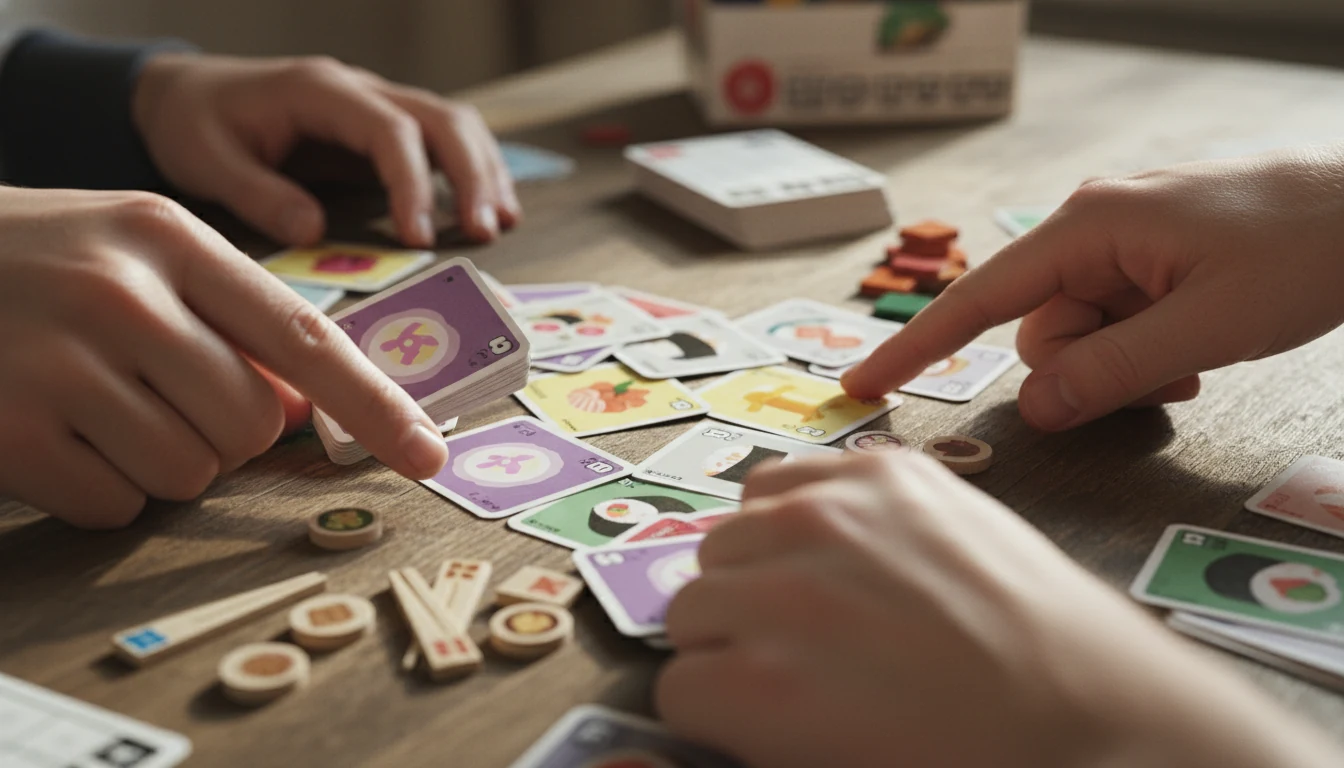
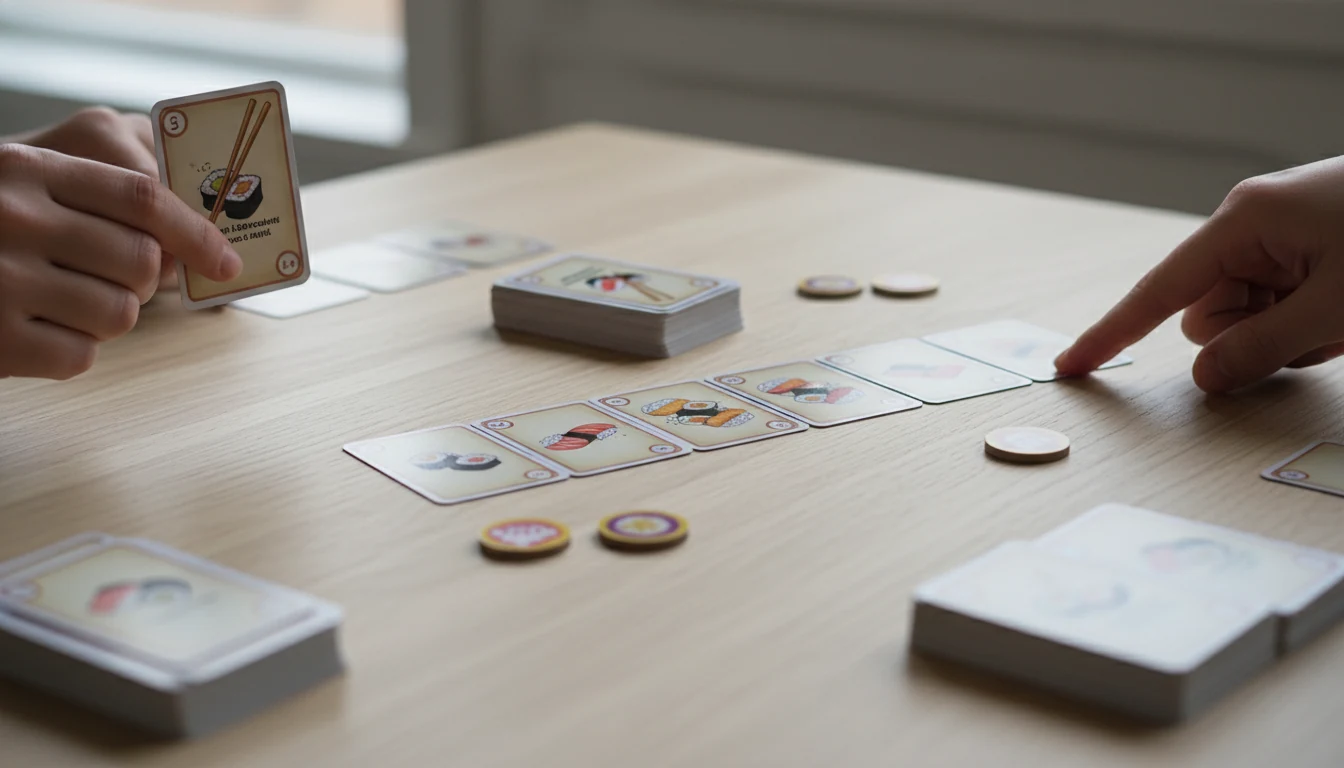
Sushi Go! rules rule situation

Common Misconceptions

  • Scoring pudding cards at the end of every round
  • Discarding pudding cards with the rest of the hand
  • Losing points for zero pudding in a 2-player game

Quick Reference

You CanYou Cannot
Keep pudding cards in front of you throughout the gameDo not discard pudding cards at the end of a round
Split tied pudding points evenly among winnersDo not apply the pudding penalty in a 2-player game

Frequently Asked Questions

What is the official rule for pudding in Sushi Go?
Pudding cards are kept until the end of the game and scored based on who has the most or fewest.
Do I lose points if I have zero pudding cards?
Yes, you lose 6 points for having the fewest pudding cards, unless you are playing with only 2 players.
How many points do I get for the most pudding?
The player with the highest number of pudding cards receives 6 points.
What happens if there is a tie for the most pudding?
The 6 points are split evenly among the players who tied for the top spot.
Categories
Board Games Card Play Rules

Sushi Go! Chopsticks Card Official Rules & How to Use

Many players mistakenly believe they can use multiple chopsticks cards at once to take even more cards, but the official rules restrict this usage.

According to the Sushi Go! Official Rulebook, the Chopsticks card allows a player to select two cards from their hand instead of one during a turn.

Sushi Go! Official Rulebook, [edition not specified], [page not specified]

These rules correspond to the UK edition of Sushi Go!.

Official Rule Breakdown

To use the Chopsticks card, a player must already have the card placed in front of them from a previous turn. During their turn, the player first chooses the first card they wish to keep as they would normally. Before the cards are revealed, the player calls out 'Sushi Go!' and selects a second card from their hand, placing it face-down on the table. After all players reveal their chosen cards, the player must put the chopsticks card back into their hand so that it is passed to the next player. While a player may have multiple chopsticks cards in front of them, they may only use one per turn (Source: Sushi Go! Official Rulebook, [page not specified]).

Step-by-Step

  1. Step 1: Choose the first card you wish to keep from your hand as usual.
  2. Step 2: Before other players reveal their cards, call out 'Sushi Go!'.
  3. Step 3: Select a second card from your hand and place it face-down on the table.
  4. Step 4: Wait for all players to reveal their chosen cards.
  5. Step 5: Put the chopsticks card back into your hand before passing your hand to the left.

Example Play Situation

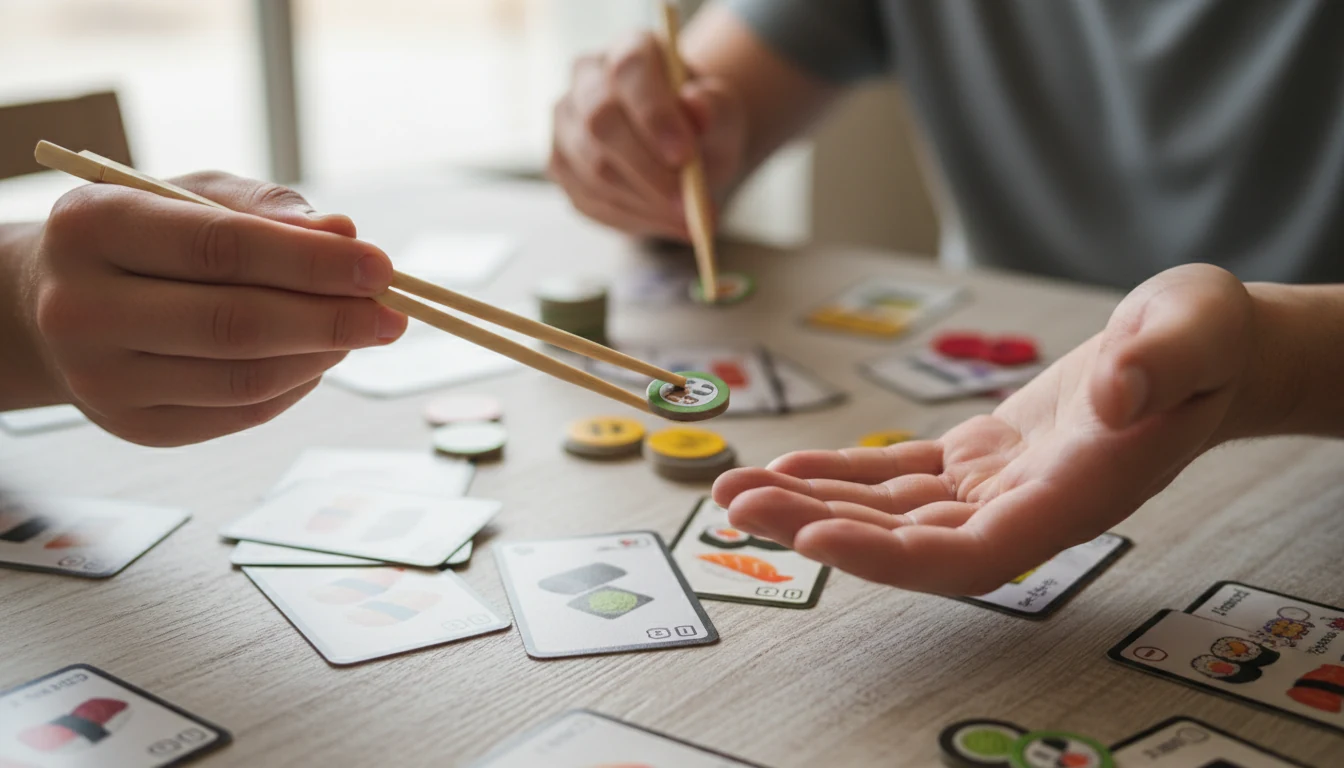
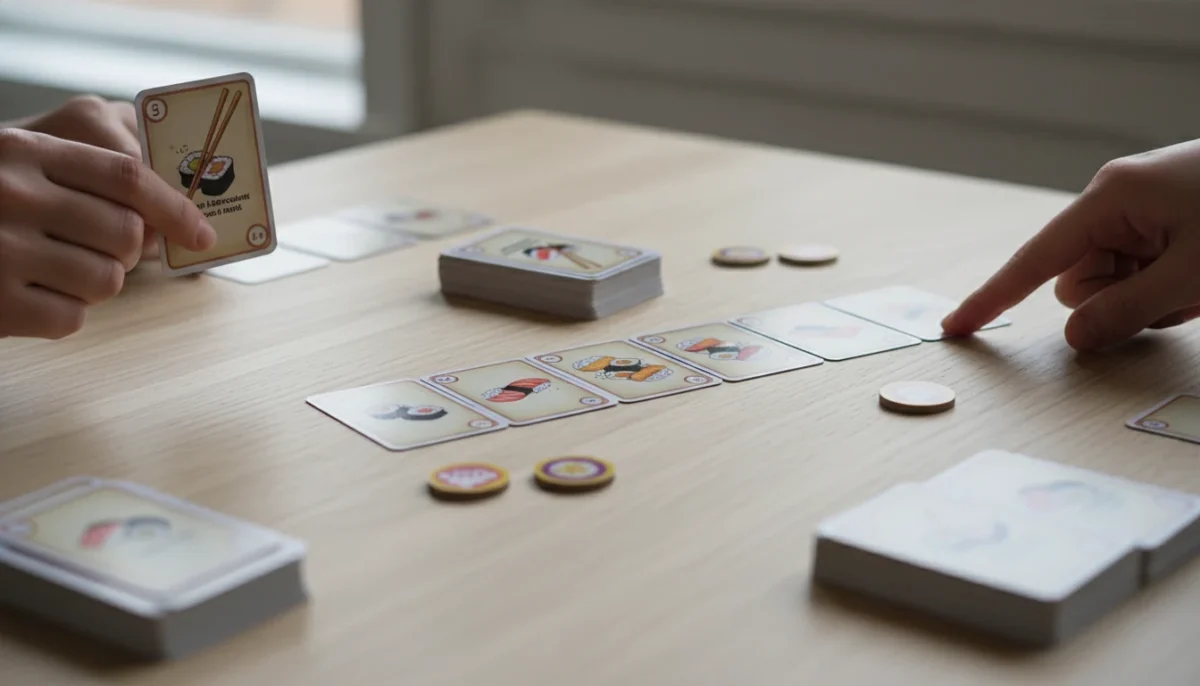
Alice has a chopsticks card in front of her. On her turn, she picks a Maki Roll and calls 'Sushi Go!', then picks a Pudding card as her second choice. After everyone reveals their cards, Alice puts her chopsticks card into her hand to be passed on.

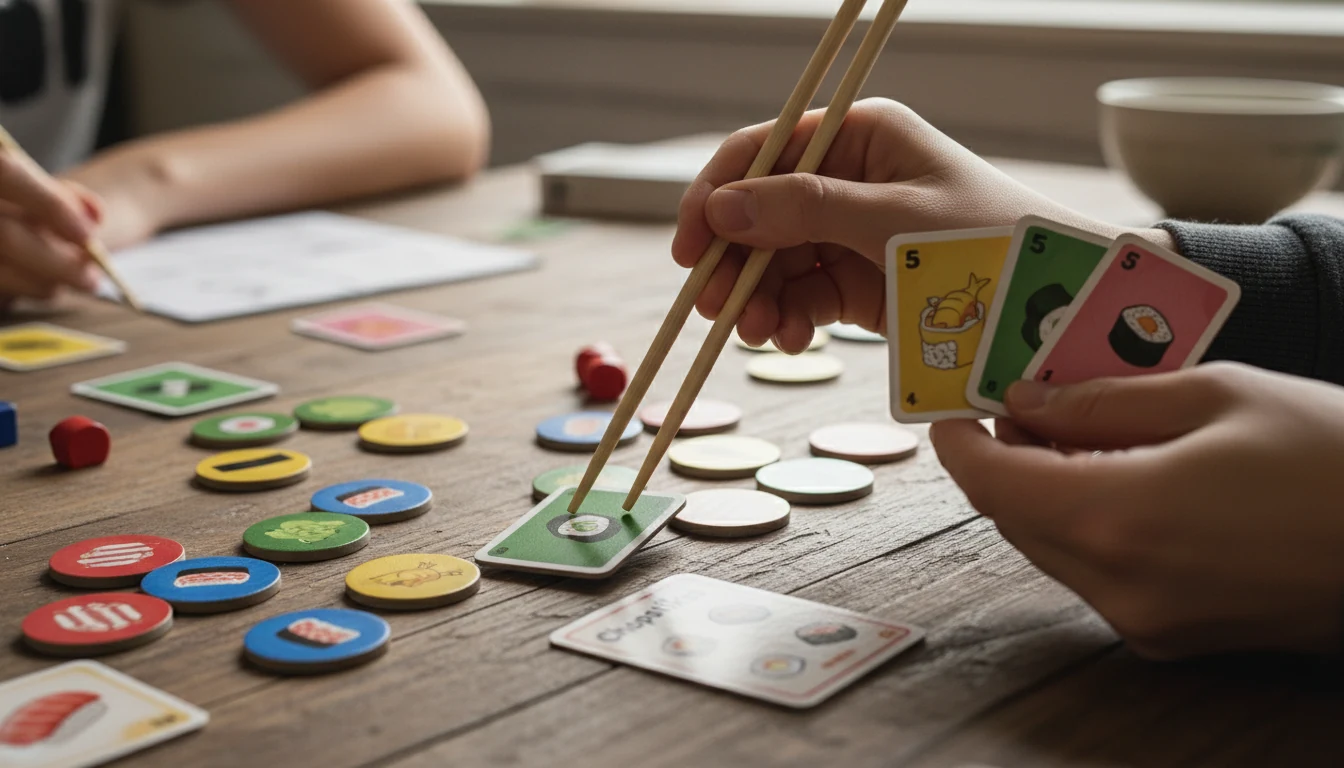
Sushi Go! rules rule situation

Common Misconceptions

  • Using multiple chopsticks cards in a single turn to take three or more cards
  • Keeping the chopsticks card in front of you to use it again immediately
  • Calling 'Sushi Go!' after the cards have already been revealed

Quick Reference

You CanYou Cannot
Call out 'Sushi Go!' before cards are revealedDo not use more than one chopsticks card per turn
Return the chopsticks card to your hand before passingDo not keep the chopsticks card in front of you after using it
Use the chopsticks card to take exactly two cards

Frequently Asked Questions

What is the official rule for using chopsticks in Sushi Go!?
You select two cards from your hand by calling 'Sushi Go!' before reveal.
Can I use two chopsticks cards at the same time?
No, you may only use one chopsticks card per turn.
Do I keep the chopsticks card in front of me after using it?
No, you must put it back into your hand so it can be passed on.
When should I say 'Sushi Go!'?
You say it after picking your first card but before everyone reveals their cards.
Categories
Board Games FAQ & Clarifications

Sushi Go! Chopsticks Exchange Rules: Official Guide

Many players mistakenly believe the Chopsticks card stays on the table to be used again immediately, but the official rules require it to be passed on.

According to the Sushi Go! Official Rulebook, the Chopsticks card must be returned to your hand before the hand-passing phase occurs.

Sushi Go! Official Rulebook, [page not specified]

These rules correspond to the US edition of Sushi Go!.

Official Rule Breakdown

The process for using Chopsticks involves a specific sequence to ensure the card is passed to the next player. If a player has a Chopsticks card in front of them, they first choose one card from their hand as usual. Before other players reveal their cards, the player calls out 'Sushi Go!' and selects a second card from their hand, placing both face-down on the table. Once all players reveal their chosen cards, the player who used the Chopsticks must put that card back into their hand. This ensures the Chopsticks card is included in the hand that is then passed to the player on their left, allowing others to potentially use it in subsequent turns. While a player may have multiple Chopsticks cards in front of them, they may only use one per turn (Source: Sushi Go! Official Rulebook, [page not specified]).

Step-by-Step

  1. Step 1: Choose the first card you wish to keep from your hand as usual.
  2. Step 2: Before others reveal their cards, call out 'Sushi Go!' and select a second card from your hand.
  3. Step 3: Place both selected cards face-down on the table.
  4. Step 4: Wait for all players to reveal their chosen cards.
  5. Step 5: Put the Chopsticks card back into your hand before passing your remaining hand to the left.

Example Play Situation

Alice has a Chopsticks card in front of her. She chooses a Tempura and then calls 'Sushi Go!' to take a second card, a Sashimi. After everyone reveals their cards, Alice puts her Chopsticks card back into her hand so that Bob receives it when she passes her hand.

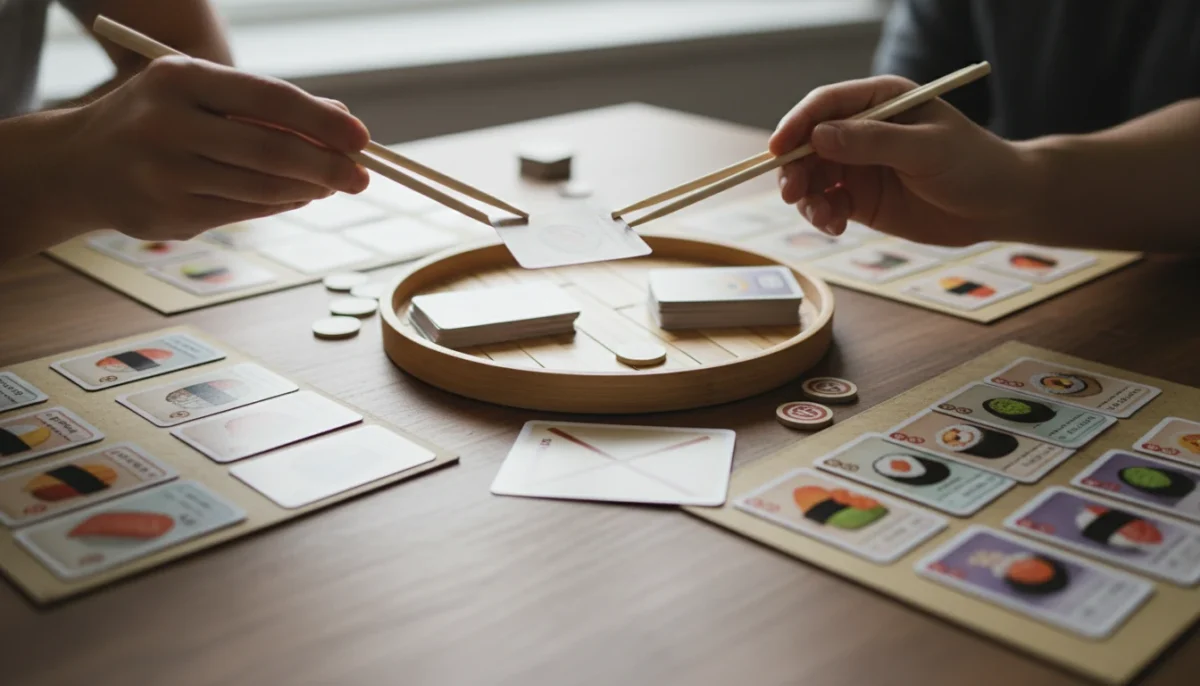
Sushi Go! rules rule situation

Common Misconceptions

  • Thinking the Chopsticks card stays on the table for the next turn
  • Using multiple Chopsticks cards at once to take more than two cards
  • Revealing the second card before calling 'Sushi Go!'

Quick Reference

You CanYou Cannot
Call out 'Sushi Go!' before revealing cardsDo not leave the Chopsticks card on the table during the pass
Return the Chopsticks card to your hand before passingDo not take three cards even if you have two Chopsticks cards
Use only one Chopsticks card per turn

Frequently Asked Questions

What is the official rule for using Chopsticks in Sushi Go!?
Call 'Sushi Go!' to take two cards, then return the Chopsticks card to your hand before passing.
Can I use two Chopsticks cards at the same time?
No, you may only use one Chopsticks card per turn.
When do I put the Chopsticks card back in my hand?
You put it back after everyone reveals their cards but before hands are passed.
Do I keep the Chopsticks card in front of me if I have two?
Yes, you can have multiple, but you only use one per turn.
Categories
Board Games Rules & Disputes

Sushi Go! Maki Roll Scoring: Official Rules Guide

Many players mistakenly believe they simply sum the values on Maki cards, but the scoring actually depends on a comparison of total icons among all players.

According to the Sushi Go! Official Rulebook, scoring Maki rolls is based on the total number of sushi roll icons collected by each player.

Sushi Go! Official Rulebook [edition not specified]

These rules correspond to the UK edition of Sushi Go!

Official Rule Breakdown

To score Maki rolls, each player must first add up the total number of sushi roll icons located at the top of all their collected Maki roll cards. A player must possess at least one Maki roll card to be eligible for this specific scoring category. Once totals are calculated, the player with the highest number of icons receives 6 points. If there is a tie for the highest number, the 6 points are split evenly (ignoring any remainder). The player with the second-highest number of icons receives 3 points, and if multiple players tie for second, those 3 points are split evenly (ignoring any remainder).

Step-by-Step

  1. Step 1: Identify all Maki roll cards collected during the round.
  2. Step 2: Count the total number of sushi roll icons at the top of those cards.
  3. Step 3: Compare your total icon count against all other players.
  4. Step 4: Award 6 points to the player(s) with the most icons or split them if tied.
  5. Step 5: Award 3 points to the player(s) with the second most icons or split them if tied.

Example Play Situation

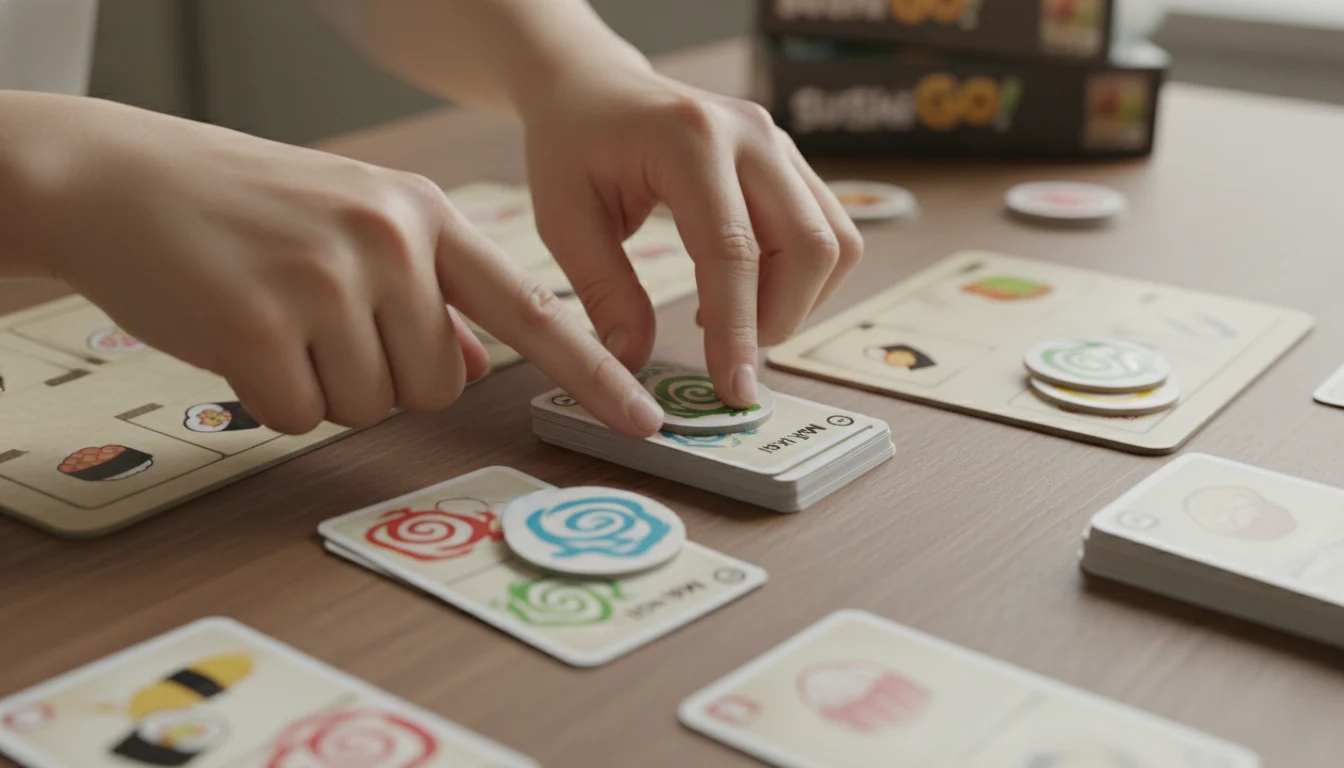
Alice has collected Maki roll cards totaling 5 icons. Bob has 5 icons, and Charlie has 3 icons. Because Alice and Bob are tied for the most, they each receive 3 points (splitting the 6 points and ignoring the remainder). Charlie has the second most icons, so he receives 3 points.

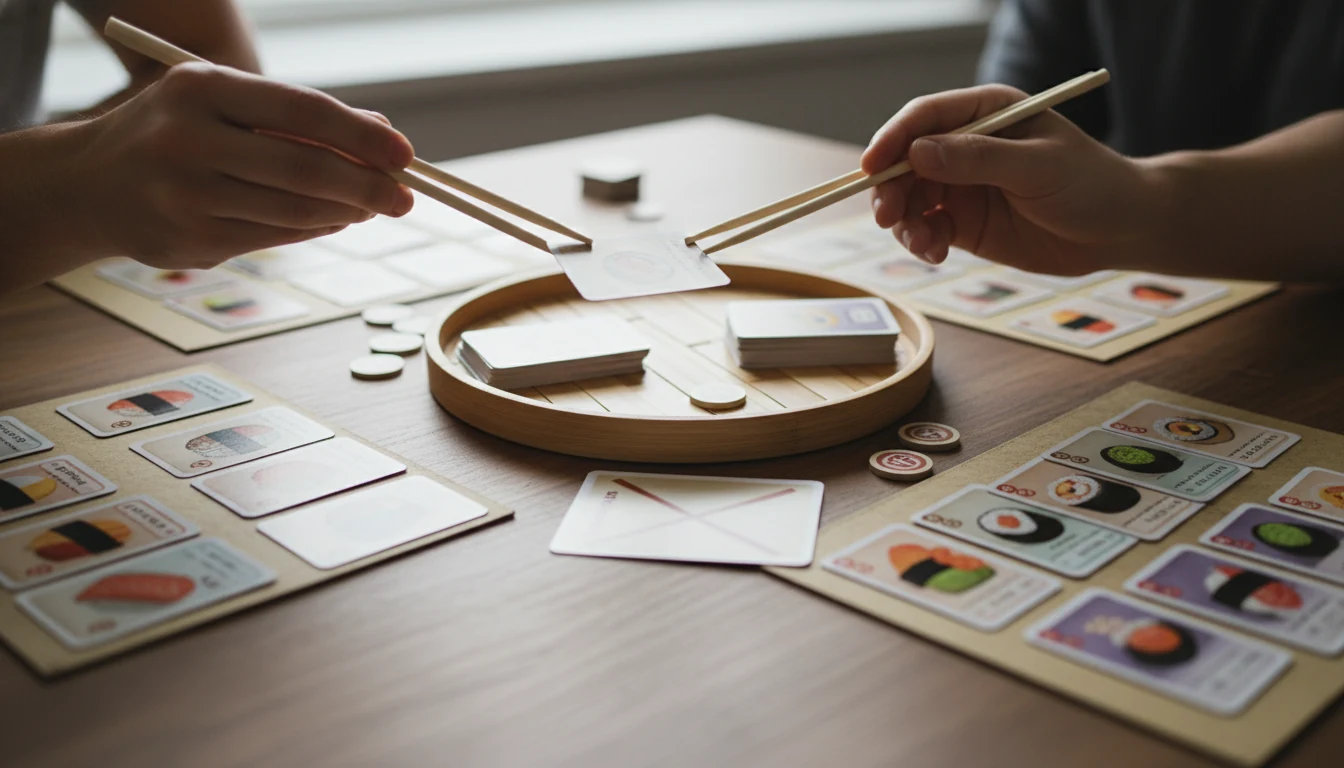
Sushi Go! rules rule situation

Common Misconceptions

  • Thinking you get points for every Maki card regardless of others
  • Forgetting that you must have at least one Maki card to qualify
  • Assuming ties result in no points being awarded

Quick Reference

You CanYou Cannot
Count the icons at the top of the cardsDo not award second place points if there is a tie for first
Split points evenly during tiesDo not count players who have zero Maki roll cards
Ignore remainders when splitting points

Frequently Asked Questions

What is the official rule for scoring Maki rolls in Sushi Go!?
Players count total icons; most icons get 6 points, second most get 3 points.
How do ties work for Maki roll points?
Tied players split the points evenly and any remainder is ignored.
Can I score Maki rolls if I have no Maki cards?
No, you must have at least 1 sushi roll card to be counted in the scoring.
What happens if two people tie for first place?
They split the 6 points evenly, and no second place points are awarded.
Categories
Board Games Scoring & Points

Sushi Go! Pudding Scoring Official Rules

Many players are unsure if the Pudding cards can result in a penalty during the final scoring phase.

According to the Sushi Go! Official Rulebook, the player with the fewest Pudding cards loses 6 points.

Sushi Go! Official Rulebook [edition not specified]

These rules correspond to the US edition of Sushi Go!.

Official Rule Breakdown

Regarding the scoring of Pudding cards, these are only tallied at the end of the game after three rounds. The player who has collected the most Pudding cards scores 6 points, with ties being split evenly (ignoring any remainder). Conversely, the player with the fewest Pudding cards (including players who have none) loses 6 points. If multiple players tie for the least amount of Pudding, the 6 lost points are split evenly among them (ignoring any remainder). In a 2-player game, the negative points for the least Pudding are not awarded.

Example Play Situation

Alice has 4 Pudding cards and Bob has 1 Pudding card. After three rounds, Alice receives 6 points for having the most, while Bob loses 6 points for having the least.

Sushi Go! rules rule situation

Common Misconceptions

  • Pudding cards are scored every round
  • Negative points apply in 2-player games
  • Tied players for least pudding both lose full points

Quick Reference

You CanYou Cannot
Keep Pudding cards in front of you after each roundDo not score Pudding at the end of individual rounds
Split tied points evenly and ignore remaindersDo not apply negative Pudding points in a 2-player game

Frequently Asked Questions

What is the official rule for Pudding scoring in Sushi Go!?
Most Pudding gets 6 points; least Pudding loses 6 points, except in 2-player games.
Do I lose points for Pudding if I am playing with only one other person?
No, in a 2-player game, no one loses points for having the least Pudding.
What happens if two players tie for the fewest Pudding cards?
The 6 lost points are split evenly between the tied players, ignoring any remainder.
When should I calculate my Pudding card score?
Pudding is only scored at the very end of the game after all three rounds are finished.
Categories
Board Games Rules & Disputes

Sushi Go! Pudding Scoring Official Rules

Many players mistakenly look for a specific scoring calculation for Pudding cards, but the rulebook treats them as part of the general card collection.

According to the Sushi Go! Official Rulebook, Pudding cards are scored as part of the cards you have collected at the end of a round.

Sushi Go! Official Rulebook, [edition not specified], [page not specified]

These rules correspond to the US edition of Sushi Go!.

Official Rule Breakdown

According to the Sushi Go! Official Rulebook, players score the cards they have collected at the end of a round. While the rulebook provides a specific detailed breakdown for Sushi Roll scoring (where the player with the most icons scores 6 points and the second most scores 3 points), Pudding cards are part of the player's collected set. The game consists of 3 rounds, and players must track their collected cards to determine the final score.

Example Play Situation

Alice collects three Pudding cards throughout the three rounds. Bob collects only one Pudding card. At the end of the game, Alice's total Pudding count is used to calculate her final score against Bob's.

Sushi Go! rules rule situation

Common Misconceptions

  • Thinking Pudding has a fixed point value like Sushi Rolls
  • Assuming Pudding scoring happens every round instead of at the end of the game
  • Confusing Pudding scoring with the Sushi Roll icon count

Quick Reference

You CanYou Cannot
Collect Pudding cards during your turnsDo not attempt to score Pudding icons like Sushi Rolls
Keep track of all collected cards for the final scoringDo not forget to include Pudding in your final card tally

Frequently Asked Questions

What is the official rule for scoring Pudding in Sushi Go!?
Pudding cards are scored based on the total number of Pudding cards you have collected.
How do I score Pudding cards at the end of the game?
You count the total number of Pudding cards in your collected pile.
Do Pudding cards work like Sushi Rolls?
No, Sushi Rolls use icon counts, while Pudding relies on the number of cards collected.
When do I count my Pudding cards?
You count them when scoring the cards you have collected at the end of the game.