Categories
Board Games Rules & Disputes

Cluedo Official Rules: Disproving Suggestions Guide

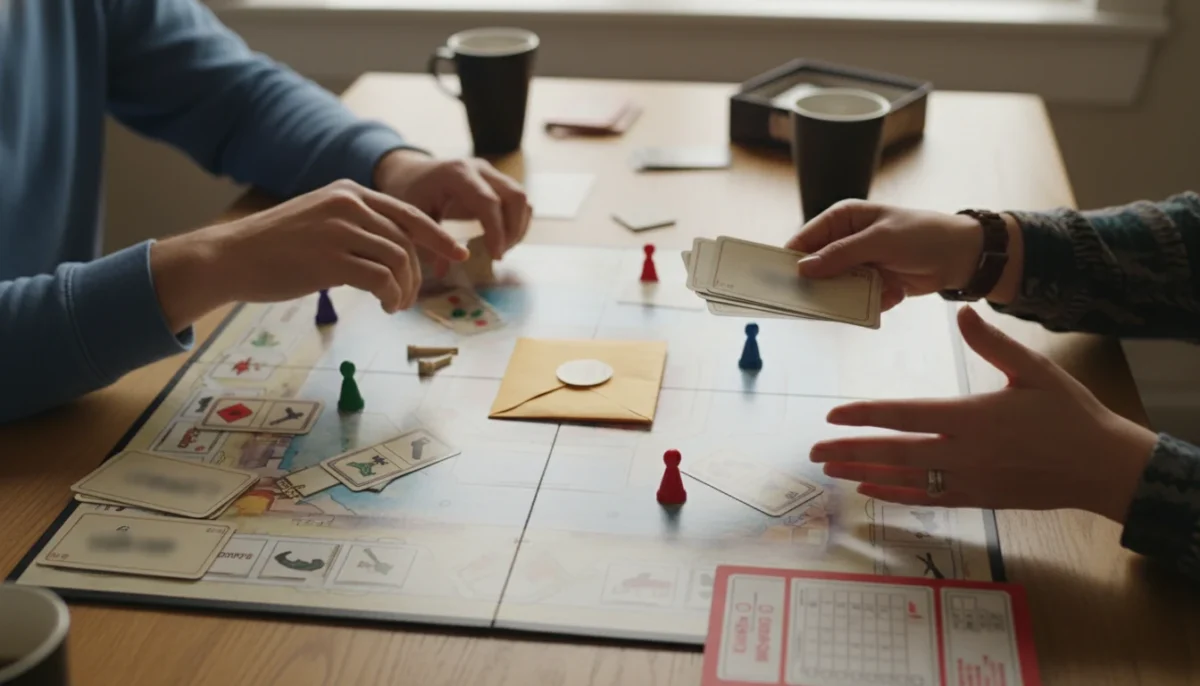
Many players mistakenly believe that a suggestion must always be refuted by another player, but the rules account for situations where no cards can be shown.

According to the Cluedo Official Rulebook, if no one can disprove a suggestion, the player has isolated one or more of the Murder Cards.

Cluedo Instructions, [edition not specified], Page 7

These rules correspond to the UK edition of Cluedo.

Official Rule Breakdown

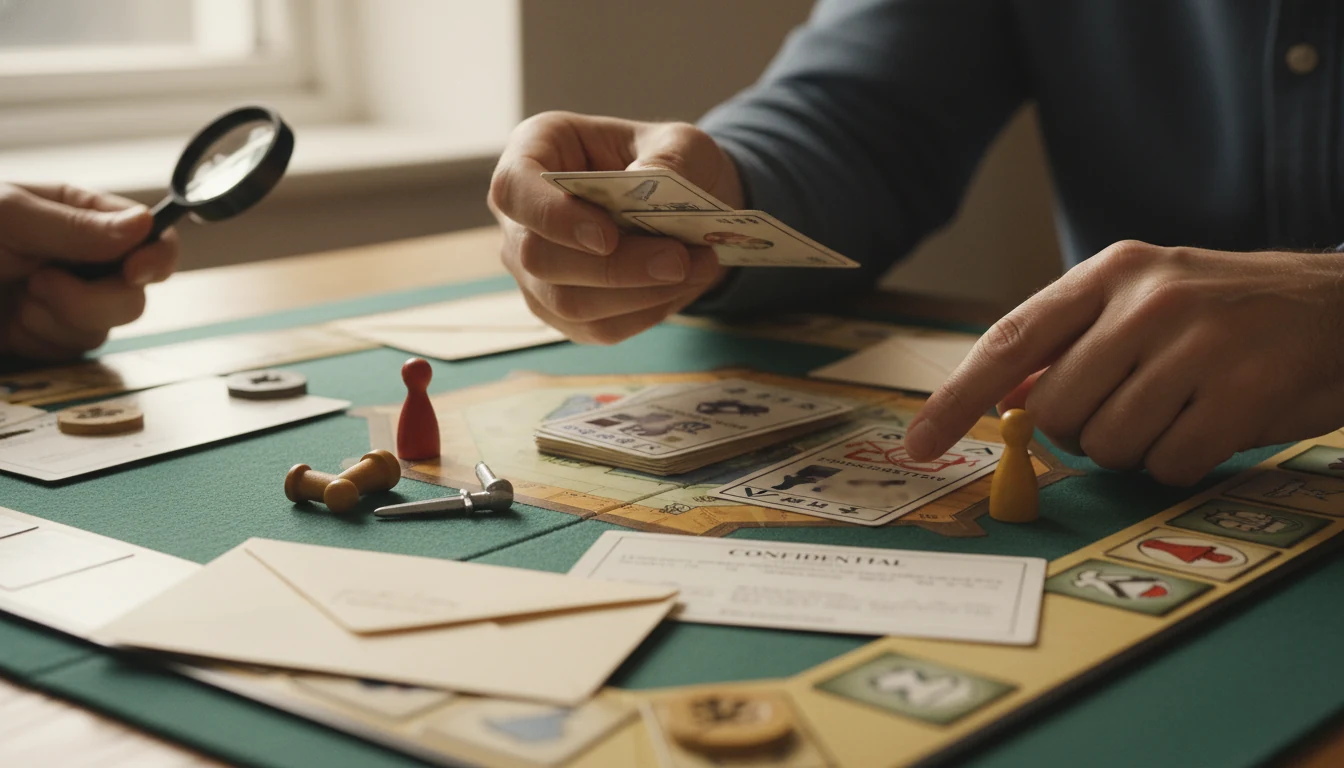
In Cluedo, when a player makes a suggestion, the player in turn must, if possible, show one clue card which refutes that suspicion. This card may be a room, person, or weapon. If the next player in turn is unable to show a clue card, the enquiry passes on to the next player after that until one card has been shown. If no one has a card to show, the player making the suggestion has isolated one or more of the 'Murder Cards' (Cluedo Instructions, Page 7).

Step-by-Step

  1. Step 1: A player makes a suggestion consisting of a suspect, a weapon, and a room.
  2. Step 2: The player in turn must attempt to show one clue card that refutes the suggestion.
  3. Step 3: If the first player cannot show a card, the enquiry passes to the next player in turn.
  4. Step 4: This process continues until a card is shown or all players have been unable to refute the suggestion.

Example Play Situation

Alice suggests that Miss Scarlett used the Dagger in the Library. Bob is asked to show a card, but he has no cards matching those items. The enquiry passes to Charlie, who also cannot show a card. Since no one can disprove the suggestion, Alice has successfully isolated the Murder Cards.
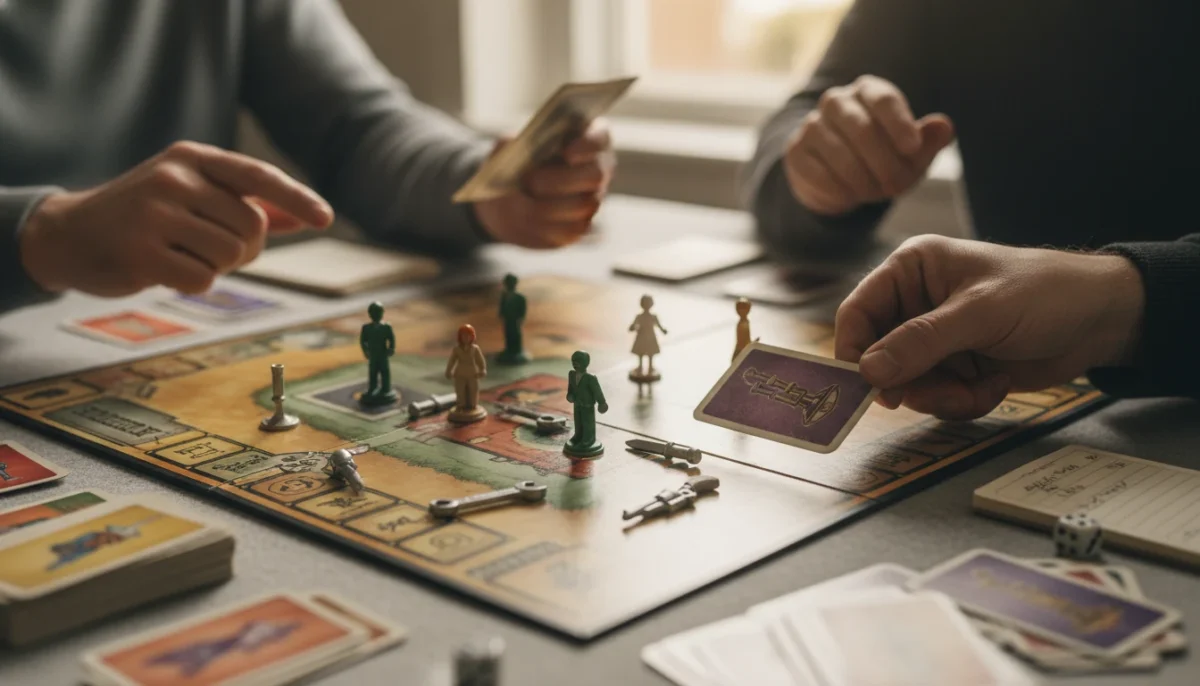
Clue/Cluedo rules rule situation

Common Misconceptions

  • Thinking the turn skips everyone if the first person can't show a card
  • Believing a suggestion must be refuted to be valid
  • Assuming you can only show a card if it is your turn

Quick Reference

You CanYou Cannot
Pass the enquiry to the next player if you cannot show a cardDo not assume a suggestion is wrong just because no one can show a card
Show a room, person, or weapon card to refute a suspicionDo not show more than one card to refute a single suggestion
Use the isolated cards to make a full accusation

Frequently Asked Questions

What is the official rule for a suggestion in Cluedo when no one can disprove it?
The player has isolated one or more of the Murder Cards.
Can I show a weapon card to refute a suggestion?
Yes, a card shown may be a room, person, or weapon.
What happens if the player in turn cannot show a clue card?
The enquiry passes to the next player in turn until a card is shown.
How do I know if I have found the murderer?
If no one can show a card to refute your suggestion, you have isolated the Murder Cards.
Categories
Board Games Turn Order & Actions

Cluedo Official Rules: How to Make a Suggestion

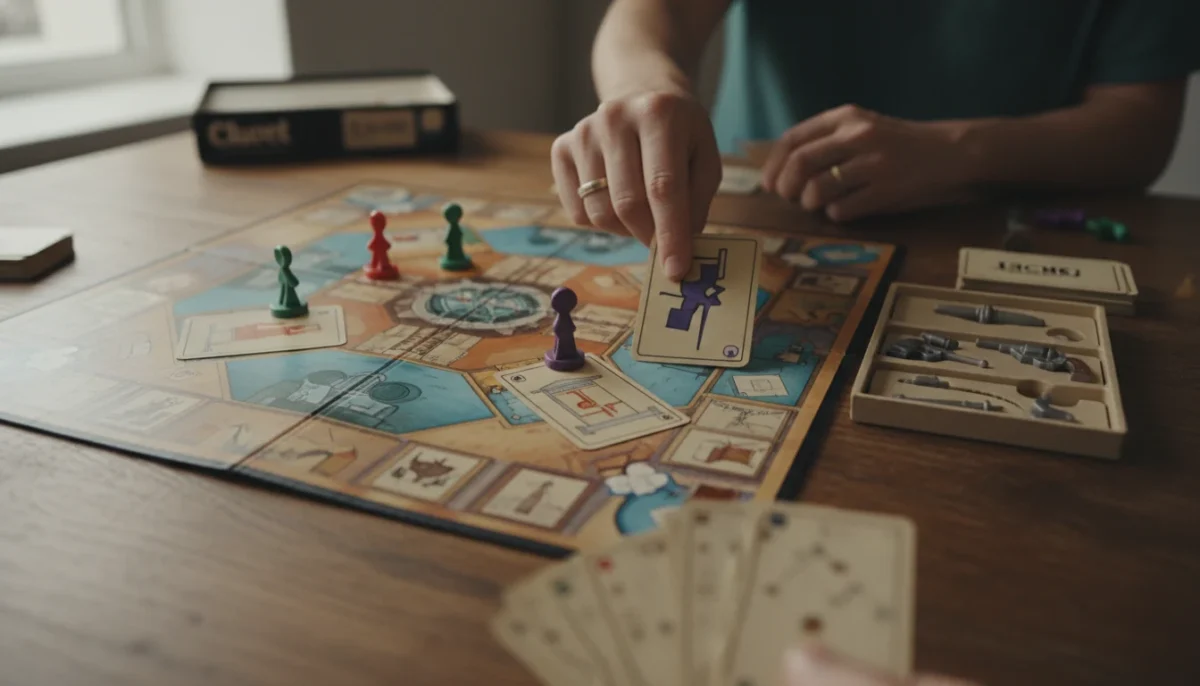
Many players wonder if they must physically move suspect and weapon tokens into a room when making a suggestion, but the official mechanics clarify this process.

According to the Waddingtons Cluedo Official Rulebook, yes, you must bring the suspect and weapon tokens into the room.

Cluedo Instructions, [edition not specified], [page not specified]

These rules correspond to the UK edition of Cluedo.

Official Rule Breakdown

When a player enters a room, they may make a suggestion about the crime by calling a suspect and a weapon into that room for enquiries. According to the Cluedo Instructions (specifically the 'On your turn, roll, move and enter a room' section), the player must bring the suspect's character token and the weapon token they are asking about into the room with them. After the suggestion is made, the player to the left must attempt to show a clue card to refute the suspicion. The character and weapon tokens remain in the room after the suggestion is made, though if a character token belongs to another player, that player can ask a question on their next turn without moving.

Step-by-Step

  1. Step 1: Roll the dice and move your character token into a room.
  2. Step 2: Select one suspect and one weapon to include in your suggestion.
  3. Step 3: Physically move the chosen suspect token and weapon token into the room you have entered.
  4. Step 4: State your suggestion (e.g., 'Was it Scarlet, with the Rope in the Garage?').
  5. Step 5: The player to your left must show you one clue card if they have it.

Example Play Situation

Alice rolls the dice and moves her token into the Kitchen. She then brings the Professor Plum token and the Dagger token into the Kitchen to suggest the murder happened there. Bob, sitting to her left, shows Alice the Plum card to refute the suggestion.

Clue/Cluedo rules rule situation

Common Misconceptions

  • Thinking you can make a suggestion without moving the tokens into the room
  • Assuming you can move through multiple rooms in one turn to reach a room
  • Believing you must roll an exact number to enter a room

Quick Reference

You CanYou Cannot
Bring the suspect and weapon tokens into the room with youDo not move diagonally across the board
Stop moving immediately upon entering a roomDo not leave a room in the same move you entered it
Ask about suspects, weapons, and rooms you haven't crossed off your sheetDo not move your piece through a square occupied by another piece

Frequently Asked Questions

What is the official rule for making a suggestion in Cluedo?
You must enter a room, bring the suspect and weapon tokens into it, and then ask your question.
Do I have to move the suspect token when I ask a question?
Yes, you must bring the suspect's character token and the weapon token into the room with you.
Can I make a suggestion if I don't enter a room?
No, you must enter a room and then you can make a suggestion about the crime.
What happens to the tokens after I make a suggestion?
The tokens stay in the room, but if a player's character token was moved, they can ask a question on their next turn.
Categories
Board Games Card Play Rules

Cluedo Official Rules: How to Show Cards for Disproving

Many players mistakenly believe that anyone can show a card to disprove a suggestion, but the rules specify a strict order of players.

According to the Hasbro Official Rulebook, the player immediately to the left of the person making the suggestion is the first to attempt to show a card.

Cluedo Instructions, [edition not specified], [page not specified]

These rules correspond to the UK edition of Cluedo.

Official Rule Breakdown

When a player enters a room and makes a CLUE question regarding a suspect, weapon, and the room, the player on their left must be the first to try to answer. If that player possesses any of the cards mentioned in the enquiry, they must show exactly one card to the player who made the suggestion secretly. They should never show more than one card. If the player on the left cannot answer, they say 'I cannot answer' and the enquiry passes to the next player in turn until a card has been shown (Cluedo Instructions, [page not specified]).

Step-by-Step

  1. Step 1: The player enters a room and makes a CLUE question about one suspect, one weapon, and the room.
  2. Step 2: The player to the left of the questioner attempts to show one relevant card secretly.
  3. Step 3: If the player to the left has no matching cards, the enquiry passes to the next player in turn.
  4. Step 4: The process continues until one player successfully shows a single clue card to the questioner.

Example Play Situation

Alice enters the Library and asks, 'Was it Mustard, with the Wrench, in the Library?'. Bob, sitting to Alice's left, looks at his cards and shows Alice the Wrench card secretly. Alice then marks the Wrench off her CLUE sheet.

Clue/Cluedo rules rule situation

Common Misconceptions

  • Showing more than one card to disprove a suggestion
  • Any player being allowed to show a card regardless of turn order
  • The player making the suggestion showing their own cards

Quick Reference

You CanYou Cannot
Show exactly one card to disprove a suggestionShow more than one card to a single enquiry
Pass the enquiry to the next player if you cannot answerShow cards to other players instead of the questioner
Mark off the card you have seen on your CLUE sheetForget to pass the enquiry if you have no matching cards

Frequently Asked Questions

What is the official rule for showing a card in Cluedo?
The player to the left of the questioner must show one card if they have it.
Can I show two cards to disprove a suggestion?
No, you should never show more than one card to the player making the enquiry.
What happens if the player on my left has no cards to show?
The enquiry passes to the next player in turn until someone can show a card.
Who is responsible for showing a card when a suggestion is made?
The player sitting to the immediate left of the person making the suggestion.
Categories
Board Games Classic Games

Monopoly Mortgage Rules: Official Rules and Clarifications

Many players mistakenly believe they can borrow money from other players to pay off debts, but the official rules strictly limit loans to the Bank via property mortgages.

According to the Monopoly Official Rulebook, money can only be loaned to a player by the Bank and only by mortgaging property.

Monopoly Official Rulebook [edition not specified]

Expertise: Board game rules expert. | Verification: Cross-referenced official rulebook text regarding mortgage interest and player loans. | Purpose: Resolve the #1 confusion regarding player-to-player loans and mortgage interest.
Key Insight: To avoid arguments, establish whether players will pay the 10% interest immediately or hold the mortgage when trading properties.

These rules correspond to the UK edition of Monopoly.

Official Rule Breakdown

To raise more money, the Bank can give mortgages on Properties. When a property is mortgaged, the owner turns the Title Deed card over to the Bank. To lift a mortgage, the owner must pay the Bank the amount of the mortgage plus 10% interest. If a player buys a mortgaged property from another player, the new owner may lift the mortgage immediately by paying the mortgage amount plus 10% interest to the Bank. Alternatively, the new owner can pay the 10% interest to retain the property with the mortgage still active; if they choose this, they must pay an additional 10% interest later when the mortgage is finally lifted. Note that when all properties in a colour-group are no longer mortgaged, the owner may begin to buy back houses at full price.

Step-by-Step

  1. Step 1: Turn the Title Deed card over to indicate it is mortgaged.
  2. Step 2: Receive the mortgage loan amount from the Bank.
  3. Step 3: To lift the mortgage, calculate the mortgage value plus 10% interest.
  4. Step 4: Pay the total amount to the Bank and turn the Title Deed card face up.

Example Play Situation

Alice owns Boardwalk but needs cash to pay a fine. She mortgages Boardwalk to the Bank to raise funds. Later, Bob buys Boardwalk from Alice; Bob pays the 10% interest immediately to keep the mortgage active, or he can pay the full amount plus interest to lift it instantly.

Monopoly rules rule situation

Common Misconceptions

  • Borrowing money directly from another player
  • Lifting a mortgage without paying the 10% interest
  • Buying houses on a mortgaged property

Quick Reference

You CanYou Cannot
You can mortgage property to get money from the BankYou cannot borrow money from another player
You can sell mortgaged property to another player at an agreed priceYou cannot collect rent on mortgaged properties
You can buy back houses at full price once all properties in a colour-group are unmortgagedYou cannot build houses on a mortgaged property

Frequently Asked Questions

What is the official rule for mortgaging in Monopoly?
The Bank loans money only by mortgaging property, and you must pay 10% interest to lift it.
Can I borrow £50 from my friend if I am short on cash?
No, players may not borrow or lend money to one another; only the Bank provides loans via mortgages.
What happens if I buy a property that is already mortgaged?
You can pay 10% interest to lift it immediately or pay 10% to keep the mortgage active.
Do I have to pay interest every turn I hold a mortgage?
No, interest is only paid when lifting the mortgage or when a new owner chooses to manage it.
Categories
Board Games Card Play Rules

Phase 10 Official Rules: Adding Cards to Laid Down Sets

Many players wonder if they can add extra cards to a Phase they have already laid down to make it larger or more complete.

According to the Mattel Official Rulebook, you may lay down more than the minimum requirements of a Phase, but only if the additional cards can be directly added to the cards already in the Phase.

Phase 10 Official Rules, Mattel Edition, [page not specified]

Expertise: Board game rules expert and content writer. | Verification: Cross-referenced official Mattel rulebook text regarding Phase laying mechanics. | Purpose: Resolve confusion regarding the legality of adding extra cards to completed Phases.
Key Insight: To avoid arguments, ensure players agree that 'extending' means the card must fit the existing sequence or number group.

These rules correspond to the UK edition of Phase 10.

Official Rule Breakdown

Regarding the ability to add cards to a Phase, the official rules state that while you must meet the minimum requirements for a Phase, you are permitted to lay down more than the minimum if the additional cards can be directly added to the cards already in the Phase. For example, if you lay down three '5s' and three '7s' to complete Phase 1, and you also hold two additional '5s' in your hand, you may immediately lay those down with the existing '5s' during the same turn. However, you cannot add cards that do not fit the existing structure; for instance, if you have completed Phase 1, you cannot add a set of '10s' because Phase 1 specifically requires exactly two sets, and adding a third set would violate the Phase's structure.

Step-by-Step

  1. Step 1: Form the minimum required combinations (sets or runs) for your current Phase in your hand.
  2. Step 2: Lay the Phase down face-up on the table before discarding.
  3. Step 3: Check if any remaining cards in your hand can be directly added to the sets or runs already laid down.
  4. Step 4: Lay down those additional cards in the same turn if they extend the existing combinations.

Example Play Situation

Alice is working on Phase 1. She lays down three '5s' and three '7s' to meet the requirement of two sets of 3. Because she also has two extra '5s' in her hand, she immediately lays them down to extend her first set. Bob, however, has a set of '10s' but cannot add them because they do not extend the '5s' or '7s' already on the table.

Phase 10 rules rule situation

House Rules

[HOUSE RULE] Some groups play a variation where 'hitting' (discarding cards onto a completed Phase) is mandatory to end a hand, though official rules focus on the Phase completion and the subsequent discard.

Common Misconceptions

  • Thinking you can add a third set to a Phase that only requires two sets.
  • Believing you can add cards to a Phase in a later hand once it is already on the table.
  • Attempting to add cards that don't match the existing numbers or sequences.

Quick Reference

You CanYou Cannot
You can add extra cards if they extend an existing setYou cannot add cards that create a new, unrequired combination
You can add extra cards if they extend an existing runYou cannot add cards that do not directly connect to the laid-down cards
You can lay down more than the minimum requirements in one turn

Frequently Asked Questions

What is the official rule for adding cards to laid down sets in Phase 10?
You can add extra cards only if they directly extend the sets or runs already in the Phase.
Can I add a third set of cards to my Phase 1 if I have them?
No, you can only add cards that directly extend the existing sets or runs required for that Phase.
What happens if I have extra cards that don't fit my Phase?
You must discard those cards to end your turn instead of laying them down.
Do I have to lay down the whole Phase at once?
Yes, you must have the entire Phase in your hand before laying it down face-up.
Categories
Board Games Strategy Games

Risk Official Rules: Defender Dice and Re-roll Guide

Many players mistakenly assume that the special advantage of re-rolling dice applies to all combatants, including the defender.

According to the Hasbro Gaming Official Rulebook, the answer is no; you cannot use the re-roll advantage when defending.

Risk Official Rules 2022, [page not specified]

These rules correspond to the UK edition of Risk.

Official Rule Breakdown

Regarding whether a defender can use the two-dice rule or re-roll mechanics, the official rules specify that the 'Advantage when attacking' rule is strictly for the attacker. While an attacker may use a RISK card to re-roll any one die during a battle involving a territory shown on their card, the rules explicitly state: 'You may not use a RISK card in this manner when defending a territory.' Furthermore, the standard dice mechanic allows a defender to roll either 1 or 2 white dice, provided they have at least 2 armies on the territory under attack. This is a standard combat mechanic rather than a card-based advantage.

Step-by-Step

  1. Step 1: The attacker announces the territory they are attacking from and the target territory.
  2. Step 2: Both players announce the number of dice they intend to roll.
  3. Step 3: The attacker rolls 1, 2, or 3 red dice (must have at least one more army than dice rolled).
  4. Step 4: The defender rolls 1 or 2 white dice (must have at least 2 armies to roll 2 dice).
  5. Step 5: Compare the highest dice; if the attacker's is higher, the defender loses an army. If the defender's is higher, the attacker loses an army.
  6. Step 6: If both rolled more than one die, compare the next-highest dice and repeat the process.

Example Play Situation

Alice is attacking Bob's territory in North Africa. Alice rolls 3 red dice and Bob rolls 2 white dice. Alice rolls a 6 and a 4, while Bob rolls a 5 and a 2. Since Alice's highest die (6) is higher than Bob's highest die (5), Bob loses one army. However, Alice cannot use a RISK card to re-roll her dice because she is the attacker, and Bob cannot use such a card to defend.

Risk rules rule situation

Common Misconceptions

  • Thinking the 'Commander' rule (changing a die to a 6) can be used during defense.
  • Assuming RISK cards can be used to re-roll dice when defending a territory.
  • Believing a defender can roll 2 dice if they only have 1 army present.

Quick Reference

You CanYou Cannot
Roll 1 or 2 dice if defending with 2 or more armiesUse a RISK card to re-roll dice while defending
Use a RISK card to re-roll one die when attackingRoll more than 3 dice as an attacker
Compare highest dice to determine casualtiesRoll 2 dice as a defender if you only have 1 army

Frequently Asked Questions

What is the official rule for defending in Risk?
Defenders roll 1 or 2 dice if they have at least 2 armies on the territory.
Can I use a RISK card to re-roll my dice when I am defending?
No, the rules state you cannot use a RISK card to re-roll dice when defending.
How many dice can a defender roll?
A defender can roll 1 or 2 dice, depending on how many armies they have.
What happens if the attacker and defender roll the same number?
In the case of a tie, the defender always wins the comparison.
Categories
Board Games Card Play Rules

Risk Card Exchange Rate Official Rules & Variations

Many players mistakenly believe that the value of a card set only increases when they personally trade them in, but the official rules track every set played by all players.

According to the Hasbro Gaming Official Rulebook, the value of card sets increases every time any player trades in a set, regardless of who played them.

Risk Rules 2022, p. 75

These rules correspond to the UK edition of Risk.

Official Rule Breakdown

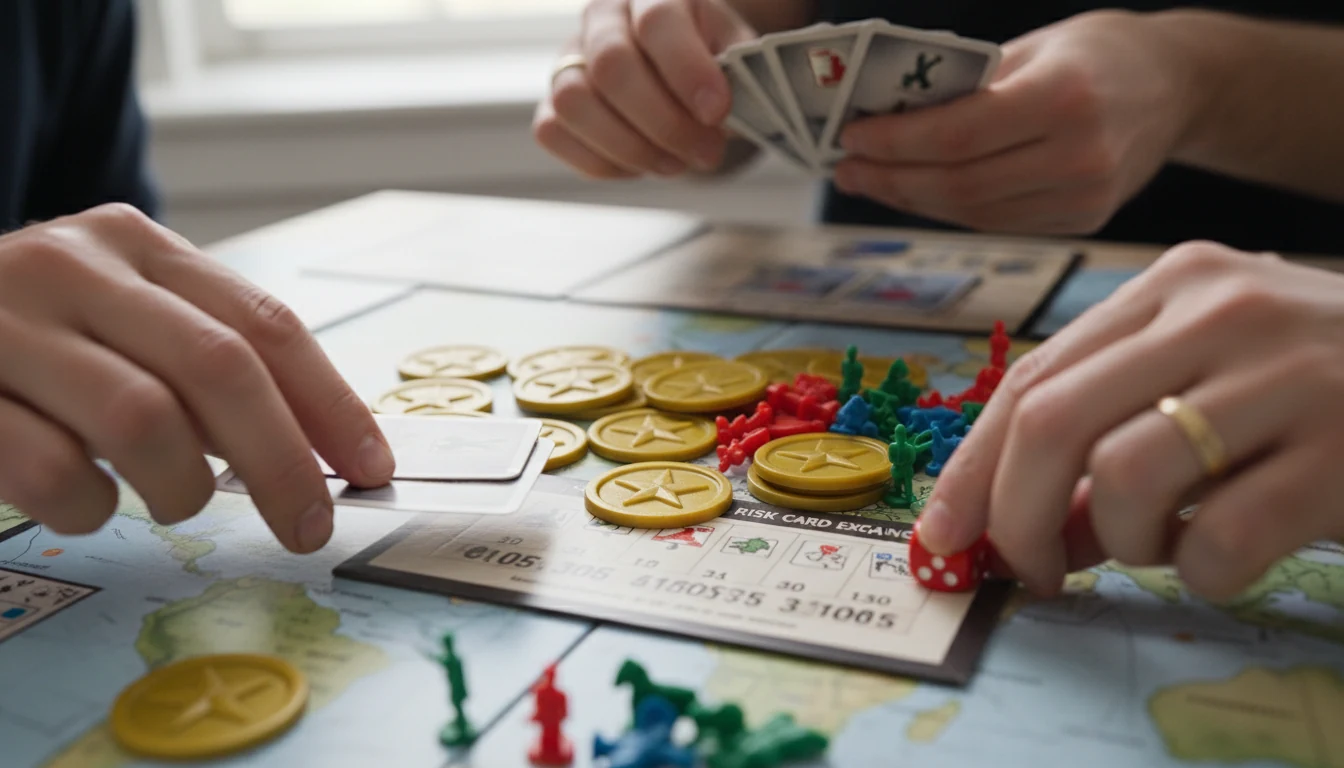
The value of matched Risk card sets increases based on the total number of sets traded in by all players throughout the game. The first set turned in is worth 4 extra armies, and the second set is worth 6 extra armies. Subsequent sets follow a specific progression: the 3rd set is worth 8 armies, the 4th is worth 10, the 5th is worth 12, the 6th is worth 15, the 7th is worth 20, the 8th is worth 25, and thereafter, each additional set increases the army count by five. For example, if a player waits until three sets have been turned in by others, their own set will be worth 10 armies (Risk Rules 2022, p. 75).

Example Play Situation

Alice has just traded in her first set of cards for 4 armies. Bob then trades in a set, which makes the next available set worth 6 armies. Later, Charlie trades in a set, meaning when Alice finally trades in her next set, it is worth 10 armies because three sets have been played in total.

Risk rules rule situation

House Rules

[HOUSE RULE] Some experienced players use a variation where the value of each matched set increases by only 1 army (e.g., 4, 5, 6, etc.) instead of the official scaling increments.

Common Misconceptions

  • The value only increases when it is your turn to trade in cards
  • The value increases by a fixed amount for every single card
  • Only the player who trades in the cards benefits from the increased value

Quick Reference

You CanYou Cannot
You can trade in sets at the beginning of your turnYou cannot trade in cards if you did not capture a territory on your last turn
You must trade in at least one set if you hold 5 or 6 cardsYou cannot hold more than 12 armies on a single territory

Frequently Asked Questions

What is the official rule for card exchange rates in Risk?
The value increases based on the total number of sets traded in by all players so far.
Does my card set value go up if another player trades in theirs?
Yes, the value of sets increases regardless of which player plays them.
How many armies is the first set of cards worth?
The first set of cards turned in is worth 4 extra armies.
What happens if I have 5 cards at the start of my turn?
You must trade in at least one set of cards.
Categories
Board Games Card Play Rules

Risk Card Trade-In Rules: Official Risk Rules Guide

Many players mistakenly believe they can hold onto Risk cards indefinitely to build up a massive army, but the rules actually mandate trading them in under certain conditions.

According to the Hasbro Gaming Official Rulebook, you must trade in at least one set if you have 5 or 6 cards at the beginning of your turn.

Risk Official Rules 2022, [page not specified]

Expertise: Board game rules expert. | Verification: Cross-referenced official 2022 rulebook text. | Purpose: Resolve the #1 confusion regarding mandatory Risk card trading.
Key Insight: To avoid arguments, ensure players count their cards clearly at the start of every turn.

These rules correspond to the UK edition of Risk.

Official Rule Breakdown

Regarding the requirement to trade in Risk cards, the official rules state that while you may choose to wait after collecting a set of 3, a mandate exists if your hand grows. Specifically, if you have 5 or 6 cards at the beginning of your turn, you must trade in at least one set. If you possess two sets within those 5 or 6 cards, you may choose to trade in a second set as well. The value of these sets is determined by the total number of sets traded in by any player throughout the game, not just by the individual player (Risk Rules 2022, [page not specified]).

Example Play Situation

Alice has 5 Risk cards at the start of her turn. According to the rules, she must trade in one set of three cards to receive armies. Bob, on his turn, has 3 cards and chooses to wait, which is permitted because he has not reached the 5-card threshold.

Risk rules rule situation

Common Misconceptions

  • Waiting to trade in cards is always allowed
  • You only trade in cards when you want to attack
  • The value of a set depends only on your own trades

Quick Reference

You CanYou Cannot
Trade in at least one set if you have 5 or 6 cardsDo not hold 5 or 6 cards without trading in a set
Trade in a second set if you have two sets within 5 or 6 cardsDo not assume your first trade is worth the same as the tenth
Use the bottom edge of the board to track the next trade value

Frequently Asked Questions

What is the official rule for trading cards in Risk?
You may trade sets at the start of your turn, but must trade if you hold 5 or 6 cards.
Can I keep all my Risk cards until I am ready to attack?
No, if you have 5 or 6 cards at the start of your turn, you must trade in at least one set.
What happens if I have 6 cards and two different sets?
You must trade in at least one set, but you are permitted to trade in both sets if you wish.
Does the number of armies I get depend on my own sets?
No, the value increases based on the total number of sets traded in by all players.