Categories
Board Games FAQ & Clarifications

Exploding Kittens Official Rules: Nope Card Timing Guide

Many players mistakenly believe a Nope card can be played to stop an Exploding Kitten after it has already been drawn, but the timing is strictly regulated.

According to the Exploding Kittens Official Rulebook, a Nope card can be played at any time before an action has begun.

Exploding Kittens Official Rules [edition not specified]

These rules correspond to the US edition of Exploding Kittens.

Official Rule Breakdown

The official rules state that a Nope card can be played at any time before an action has begun, even if it is not your turn. This card is used to stop any action except for an Exploding Kitten or a Defuse Card. Once an action has commenced, the window to play a Nope has closed. Additionally, the rules specify that you can play a Nope on another Nope to negate it and create a 'Yup'.

Example Play Situation

Alice plays a See the Future card to peek at the deck. Bob immediately plays a Nope card to cancel her action. Because the action had not yet been completed, the Nope successfully negates Alice's ability to see the cards.
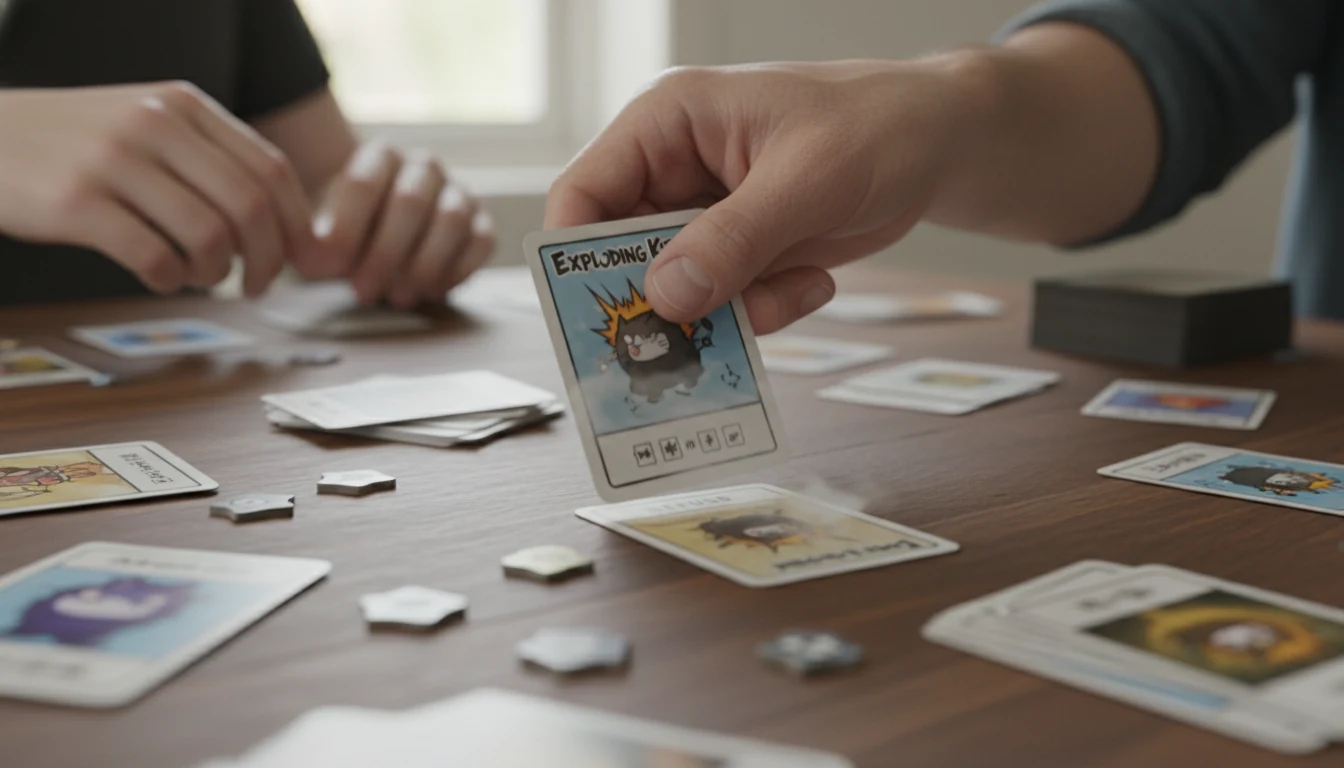
Exploding Kittens rules rule situation

Common Misconceptions

  • Thinking a Nope can stop an Exploding Kitten card
  • Believing a Nope can be played after an action has already started
  • Assuming a Nope card can only be played on your own turn

Quick Reference

You CanYou Cannot
Play a Nope at any time before an action beginsUse a Nope to stop an Exploding Kitten
Play a Nope on another Nope to create a YupUse a Nope to stop a Defuse Card
Use a Nope to stop most special actionsPlay a Nope after an action has already started

Frequently Asked Questions

What is the official rule for playing a Nope in Exploding Kittens?
You can play it any time before an action starts, even if it isn't your turn.
Can I use a Nope card to stop an Exploding Kitten?
No, the rules state you cannot use a Nope to stop an Exploding Kitten or a Defuse Card.
Is it too late to play a Nope if the card is already being played?
Yes, the Nope must be played before the action has begun to be valid.
What happens if I play a Nope on another Nope?
It negates the card and creates a 'Yup'.
Categories
Board Games Card Play Rules

Phase 10 Skip Card Official Rules & How to Play

Many players mistakenly believe Skip cards can be used to complete a Phase or be picked up from the discard pile.

According to the Phase 10 Official Rulebook, Skip cards serve only one purpose: to cause another player to lose a turn.

Phase 10 Official Rules [edition not specified]

Expertise: Board game rules expert. | Verification: Cross-referenced official rulebook text. | Purpose: Resolve the #1 confusion regarding Skip card utility in Phase 10.
Key Insight: To avoid arguments, ensure everyone agrees on when a 'round' begins before the first Skip card is played.

These rules correspond to the UK edition of Phase 10.

Official Rule Breakdown

The official rules specify that Skip cards have a singular function: to force another player to lose their turn. When a player draws a Skip card, they have the option to discard it immediately or save it for a later turn. However, a Skip card may never be used to contribute to making Phase 8 or any other Phase. Additionally, Skip cards cannot be picked up from the discard pile. A critical limitation is that only one Skip card may be used against each individual player per 'round' (defined as one full circuit around the table). If the dealer begins the discard pile with a Skip card, the first player's turn is automatically skipped.

Step-by-Step

  1. Step 1: Draw a card from either the draw pile or the discard pile.
  2. Step 2: If the card is a Skip card, decide to discard it immediately or save it for a later turn.
  3. Step 3: On a subsequent turn, discard the Skip card onto the discard pile.
  4. Step 4: Choose the specific player who will lose their turn.

Example Play Situation

Alice draws a Skip card and decides to save it. Two turns later, Alice discards the Skip card and chooses Bob to lose his turn. Bob must now skip his turn and cannot draw or discard.

Phase 10 rules rule situation

Common Misconceptions

  • Using a Skip card to complete a Phase
  • Picking up a Skip card from the discard pile
  • Using multiple Skip cards against the same player in one round

Quick Reference

You CanYou Cannot
Discard the Skip card to make a player lose a turnUse a Skip card to complete any Phase
Save a Skip card to use on a later turnPick up a Skip card from the discard pile
Skip the first player if the dealer starts the pile with a Skip cardUse more than one Skip card against the same player per round

Frequently Asked Questions

What is the official rule for Skip cards in Phase 10?
They are used only to make another player lose their turn and cannot be used in Phases.
Can I use a Skip card to help me finish Phase 8?
No, Skip cards may never be used in making Phase 8 or any other Phase.
What happens if the dealer puts a Skip card on the discard pile to start?
The first player's first turn is automatically skipped.
Is it allowed to pick up a Skip card from the discard pile?
No, a Skip card may never be picked up from the discard pile.
Categories
Board Games FAQ & Clarifications

Sushi Go! Chopsticks Exchange Rules: Official Guide

Many players mistakenly believe the Chopsticks card stays on the table to be used again immediately, but the official rules require it to be passed on.

According to the Sushi Go! Official Rulebook, the Chopsticks card must be returned to your hand before the hand-passing phase occurs.

Sushi Go! Official Rulebook, [page not specified]

These rules correspond to the US edition of Sushi Go!.

Official Rule Breakdown

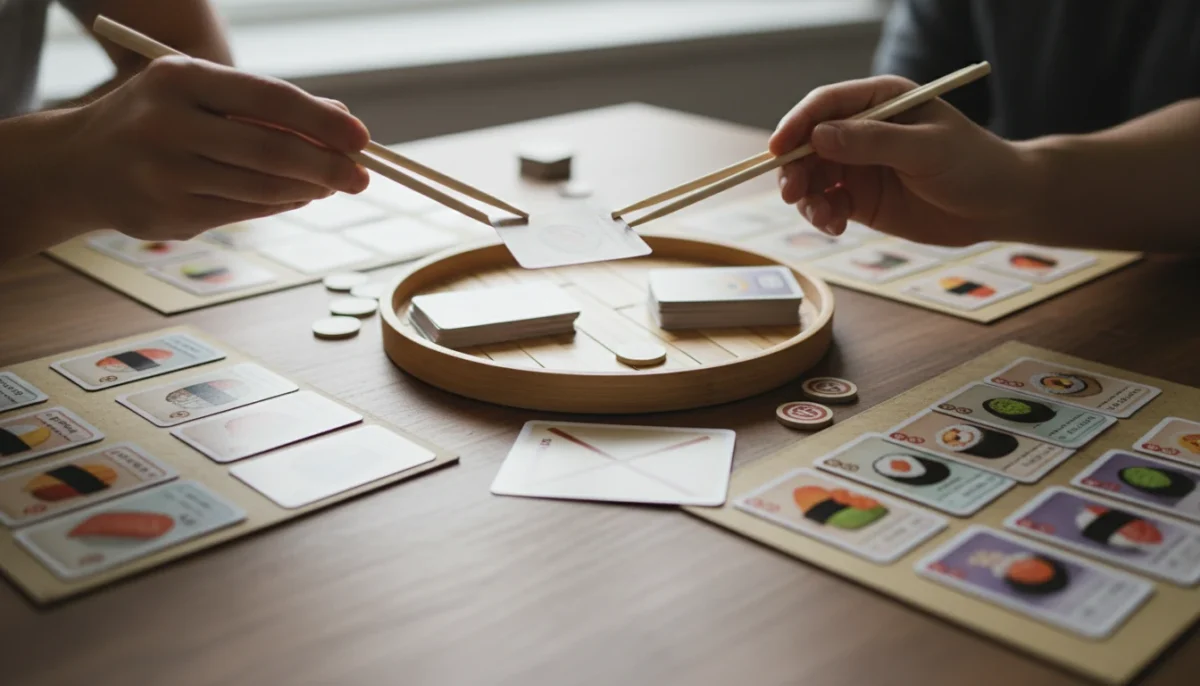
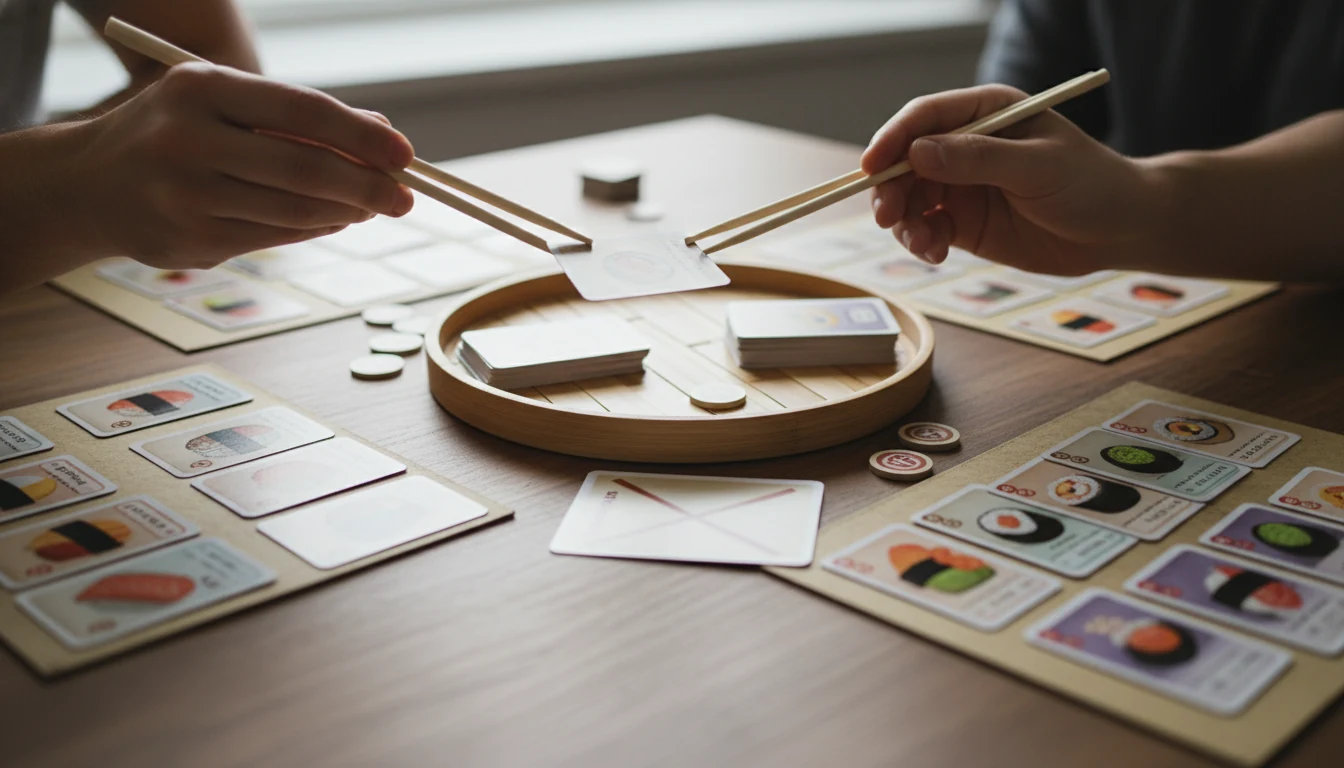
The process for using Chopsticks involves a specific sequence to ensure the card is passed to the next player. If a player has a Chopsticks card in front of them, they first choose one card from their hand as usual. Before other players reveal their cards, the player calls out 'Sushi Go!' and selects a second card from their hand, placing both face-down on the table. Once all players reveal their chosen cards, the player who used the Chopsticks must put that card back into their hand. This ensures the Chopsticks card is included in the hand that is then passed to the player on their left, allowing others to potentially use it in subsequent turns. While a player may have multiple Chopsticks cards in front of them, they may only use one per turn (Source: Sushi Go! Official Rulebook, [page not specified]).

Step-by-Step

  1. Step 1: Choose the first card you wish to keep from your hand as usual.
  2. Step 2: Before others reveal their cards, call out 'Sushi Go!' and select a second card from your hand.
  3. Step 3: Place both selected cards face-down on the table.
  4. Step 4: Wait for all players to reveal their chosen cards.
  5. Step 5: Put the Chopsticks card back into your hand before passing your remaining hand to the left.

Example Play Situation

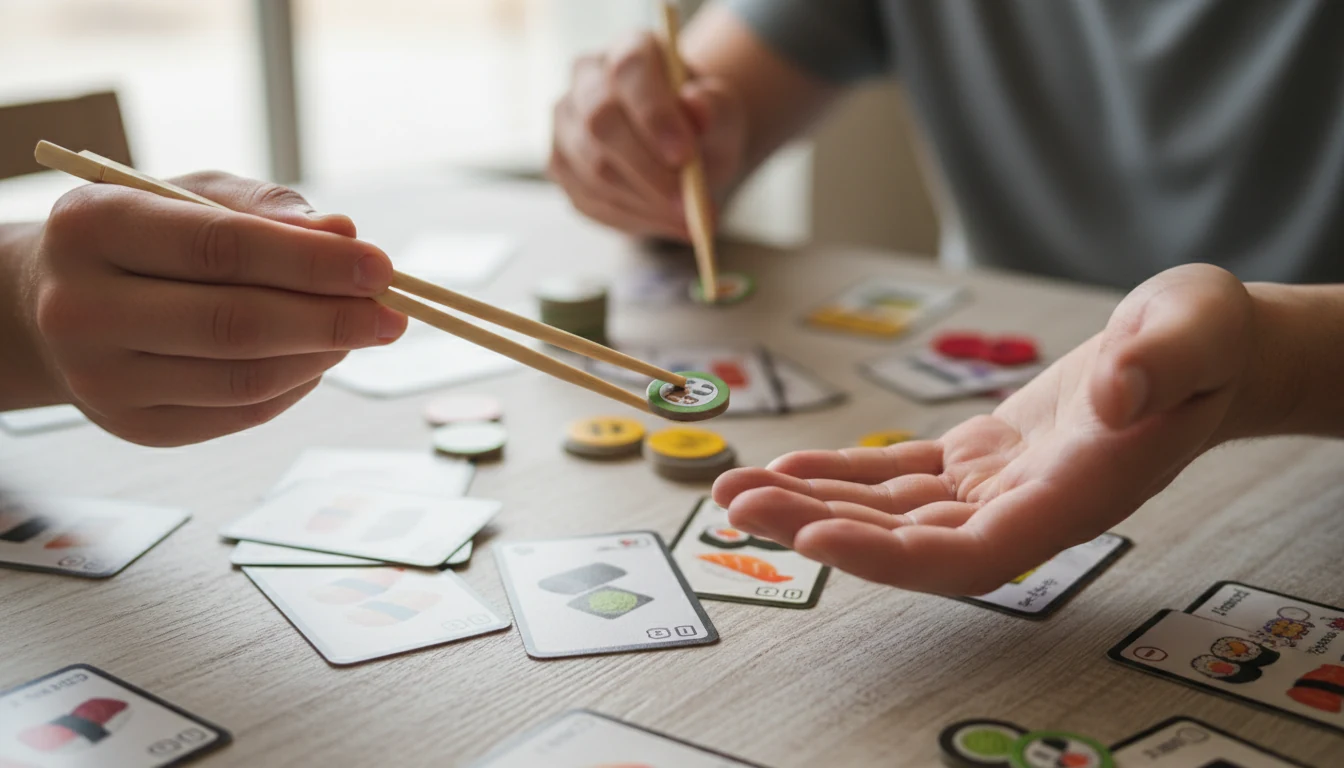
Alice has a Chopsticks card in front of her. She chooses a Tempura and then calls 'Sushi Go!' to take a second card, a Sashimi. After everyone reveals their cards, Alice puts her Chopsticks card back into her hand so that Bob receives it when she passes her hand.

Sushi Go! rules rule situation

Common Misconceptions

  • Thinking the Chopsticks card stays on the table for the next turn
  • Using multiple Chopsticks cards at once to take more than two cards
  • Revealing the second card before calling 'Sushi Go!'

Quick Reference

You CanYou Cannot
Call out 'Sushi Go!' before revealing cardsDo not leave the Chopsticks card on the table during the pass
Return the Chopsticks card to your hand before passingDo not take three cards even if you have two Chopsticks cards
Use only one Chopsticks card per turn

Frequently Asked Questions

What is the official rule for using Chopsticks in Sushi Go!?
Call 'Sushi Go!' to take two cards, then return the Chopsticks card to your hand before passing.
Can I use two Chopsticks cards at the same time?
No, you may only use one Chopsticks card per turn.
When do I put the Chopsticks card back in my hand?
You put it back after everyone reveals their cards but before hands are passed.
Do I keep the Chopsticks card in front of me if I have two?
Yes, you can have multiple, but you only use one per turn.
Categories
Board Games Card Play Rules

UNO Official Rules: When to Say UNO and Penalties

Many players mistakenly believe they must shout 'UNO' when they have one card left, but they often forget the specific timing required to avoid penalties.

According to the Mattel Official Rulebook, you must yell "UNO" when you play your next-to-last card to indicate you have only one card remaining.

UNO Official Rules [edition not specified], p.[page not specified]

Expertise: Board game rules expert with extensive experience in Mattel card game mechanics. | Verification: Cross-referenced official rulebook text regarding the 'Going Out' section. | Purpose: Resolve the #1 confusion regarding the timing of the 'UNO' declaration.
Key Insight: To avoid arguments, ensure everyone agrees on the exact moment the 'next player' begins their turn before starting.

These rules correspond to the UK edition of UNO.

Official Rule Breakdown

According to the official UNO® card game rules, the requirement to say 'UNO' occurs specifically when a player plays their next-to-last card. This action serves to indicate that the player has only one card left in their hand. If a player fails to yell 'UNO' and is caught by another player before the next player begins their turn, that player must draw two cards as a penalty.

Step-by-Step

  1. Step 1: Hold your cards and wait for your turn.
  2. Step 2: Play a card that leaves you with exactly one card remaining in your hand.
  3. Step 3: Immediately yell "UNO" to declare your status.
  4. Step 4: Wait for the next player to begin their turn to ensure your declaration is valid.

Example Play Situation

Alice plays a Red 5, leaving her with only one card in her hand. She immediately yells "UNO". Bob begins his turn, so Alice's declaration is successful and she is not penalised.

Uno rules rule situation

House Rules

[HOUSE RULE] Some players implement 'Jump-In' rules where players can play a matching card out of turn, or 'Progressive UNO' where Draw Two cards can be stacked to increase the penalty.

Common Misconceptions

  • Yelling 'UNO' when you have zero cards left instead of one.
  • Thinking you can yell 'UNO' after the next player has already started their turn.
  • Believing you only need to say it when you win the round.

Quick Reference

You CanYou Cannot
Yell 'UNO' when playing your second-to-last cardWait until you have zero cards to say 'UNO'
Declare your status before the next player starts their turnForget to yell 'UNO' if you want to avoid drawing two cards

Frequently Asked Questions

What is the official rule for saying UNO in UNO?
You must yell 'UNO' when playing your next-to-last card to show you have one card left.
Is it allowed to say UNO after the next player starts their turn?
No, you must be caught before the next player begins their turn to avoid the penalty.
What happens if I forget to say UNO?
If caught before the next turn starts, you must draw two cards.
When do I have to yell UNO?
Exactly when you play the card that leaves you with only one card remaining.
Categories
Board Games Card Play Rules

Can You Play Draw 2 on Draw 4? UNO Official Rules

Many players mistakenly believe they can mix different types of draw cards to stack penalties, but standard play follows specific limitations.

No, according to the Mattel Official Rulebook, standard UNO rules do not allow stacking a Draw Two on a Wild Draw Four.

UNO Official Rules 2008, [page not specified]

Expertise: Board game rules expert. | Verification: Cross-referenced official 2008 Mattel rulebook content. | Purpose: Resolve the #1 stacking confusion from player forums regarding mixed draw card types.
Key Insight: To avoid arguments, establish whether you are playing standard rules or the Progressive UNO house rule before the first card is dealt.

These rules correspond to the US edition of UNO.

Official Rule Breakdown

In the standard UNO rulebook, if the last card played in a round is a Draw Two or Wild Draw Four, the next player must draw the 2 or 4 cards respectively. The rules do not provide a mechanism for playing a Draw Two card on top of a Wild Draw Four to increase the penalty. Stacking is specifically a feature of the 'Progressive UNO' house rule variant, where players can play consecutive Draw Two cards or consecutive Wild Draw Four cards to increase the total cards drawn.

Example Play Situation

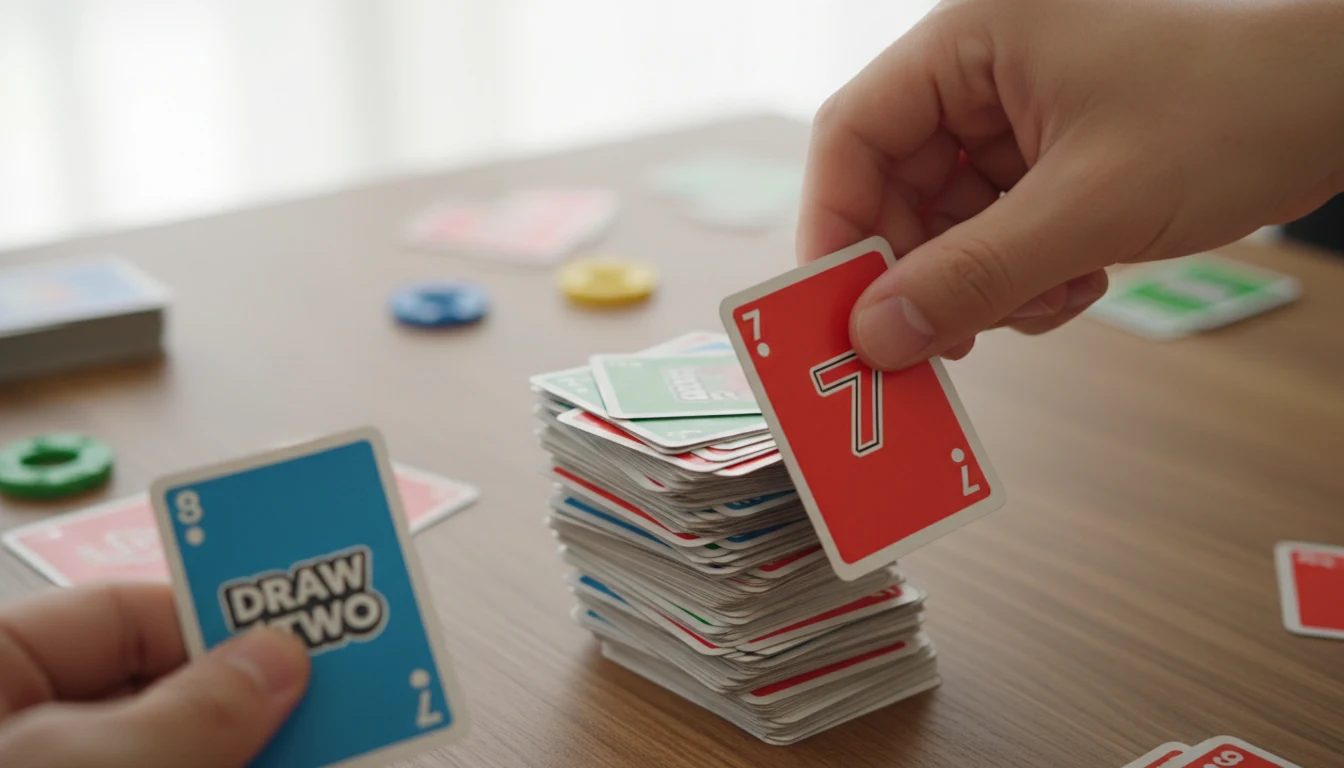
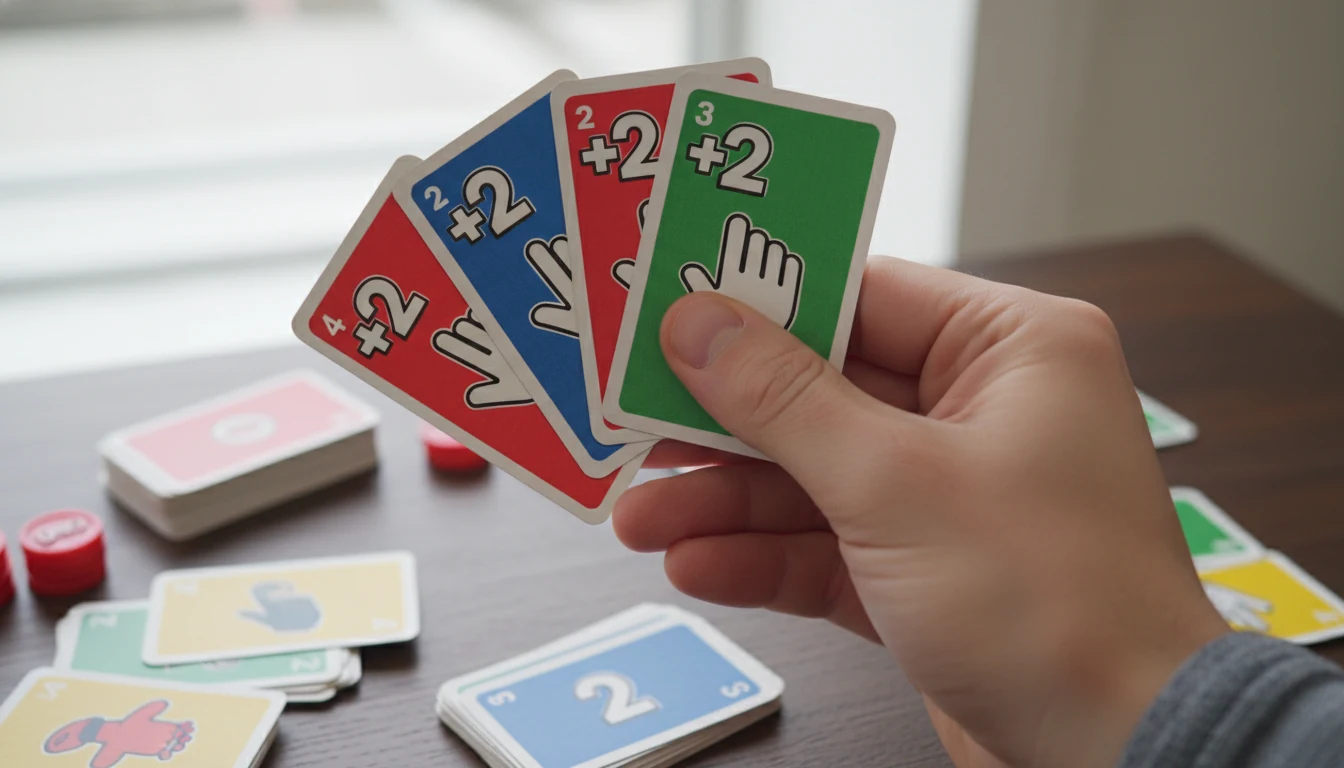
Alice plays a Wild Draw Four card. Bob is the next player and must draw 4 cards. Bob cannot play a Draw Two card to increase the penalty because the cards do not match the required type for the Progressive house rule.

Uno rules rule situation

House Rules

[HOUSE RULE] In the 'Progressive UNO' variant, players may play a second Draw Two to make the next player draw 4, or a second Wild Draw Four to make the next player draw 8. Players can continue this chain as long as they have the matching cards in their hands.

Common Misconceptions

  • Mixing Draw Two and Wild Draw Four cards to stack penalties
  • Assuming all draw cards can be stacked regardless of type
  • Thinking standard rules allow for 'chaining' draw penalties

Quick Reference

You CanYou Cannot
Draw the specified number of cards when a draw card is played on youPlay a Draw Two on a Wild Draw Four in standard play
Use the Progressive UNO house rule to stack identical draw cardsStack different types of draw cards to increase penalties

Frequently Asked Questions

What is the official rule for stacking in UNO?
Standard rules do not allow stacking; it is only available in the Progressive UNO house rule variant.
Can I play a Draw Two on a Wild Draw Four?
No, you cannot mix these card types under standard rules or the Progressive house rule.
Is it allowed to stack two Wild Draw Four cards?
Yes, if you are playing with the Progressive UNO house rule, the next player draws 8 cards.
What happens if I play a Draw Two illegally?
If challenged and found guilty, you must follow the standard penalty rules for that card.
Categories
Board Games Strategy Games

Catan Cities & Knights Robber Rules: Official Rules Guide

Many players mistakenly believe they can only move the robber to a hex adjacent to their current position, but the official rules allow for more flexibility.

According to the Catan GmbH Official Rulebook, you may move the robber to any numbered hex when chasing it away or using specific progress cards.

Catan Cities & Knights Official Rulebook, [edition not specified]

Expertise: Board game rules expert and technical writer. | Verification: Cross-referenced official Catan Cities & Knights rulebook pages regarding knight actions and robber displacement. | Purpose: Resolve the #1 dispute regarding robber placement limits in the Cities & Knights expansion.
Key Insight: To avoid arguments, ensure all players agree that the robber must land on a numbered hex before the move is completed.

These rules correspond to the US edition of Catan.

Official Rule Breakdown

In Catan: Cities & Knights, there are two primary ways to move the robber. First, when using an active knight to 'chase away' the robber, the knight must be adjacent to one of the three hexes the robber occupies. Upon displacing the robber, you move it to any numbered hex and steal one resource from any player who has a settlement or city adjacent to that new hex (Catan Cities & Knights Official Rulebook, 'Chasing Away the Robber'). Second, certain Progress Cards, such as the Bishop card, allow you to move the robber following normal rules, which involves moving it to a new hex and potentially drawing cards from players adjacent to the new location (Catan Cities & Knights Official Rulebook, 'City Development').

Step-by-Step

  1. Step 1: Ensure your active knight is adjacent to one of the three hexes the robber currently occupies.
  2. Step 2: Choose a new numbered hex anywhere on the board to place the robber.
  3. Step 3: Identify players with a settlement or city adjacent to the new hex.
  4. Step 4: Steal one resource from one of those adjacent players.
  5. Step 5: Turn your knight token to its inactive side.

Example Play Situation

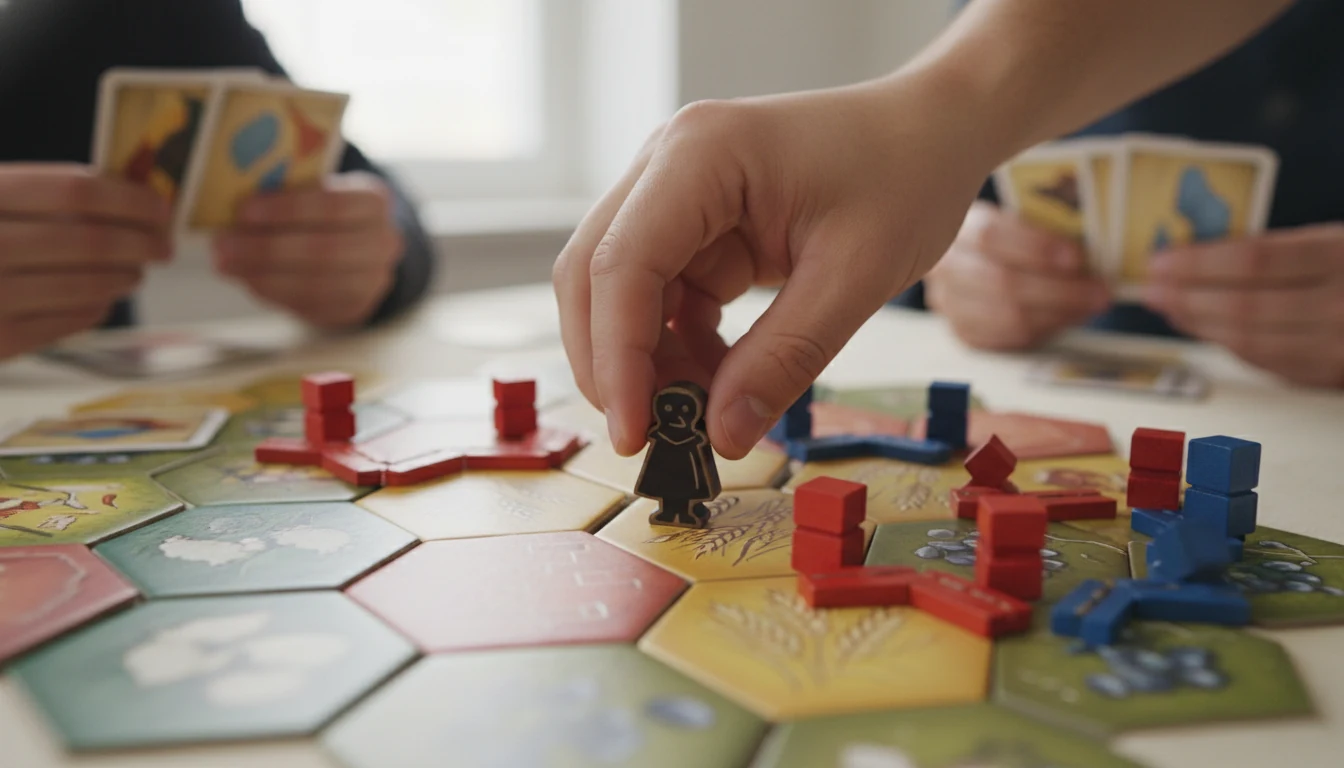
Alice has an active knight adjacent to the robber's current hex. She uses her knight to chase the robber away, moving it to a distant mountain hex. Bob, who has a settlement next to that mountain, must then give Alice one random resource.

Catan rules rule situation

Common Misconceptions

  • The robber can only be moved to an adjacent hex.
  • Knights can only chase the robber if they are the strongest knight.
  • You can move the robber to a desert hex.

Quick Reference

You CanYou Cannot
Move the robber to any numbered hex when chasing it awayDo not move the robber to a desert hex
Steal one resource from an adjacent player after moving the robberDo not attempt to chase the robber if your knight is not adjacent to the robber's hex
Turn your knight to the inactive side after chasing the robberDo not forget to deactivate your knight after the action

Frequently Asked Questions

What is the official rule for moving the robber in Catan Cities & Knights?
Move the robber to any numbered hex and steal one resource from an adjacent player.
Can I move the robber to a desert hex when using a knight?
No, the rules specify moving the robber to a numbered hex.
Is it allowed to steal from a player if they have two settlements next to the robber?
Yes, but you can only steal one card from that player regardless of their settlement count.
What happens if I use a knight to chase the robber?
The robber moves to a numbered hex, you steal a resource, and your knight becomes inactive.
Categories
Board Games Penalties & Draw Cards

Exploding Kittens NOPE Card Stacking Official Rules

Many players wonder if they can stack multiple NOPE cards to create an endless chain of negations.

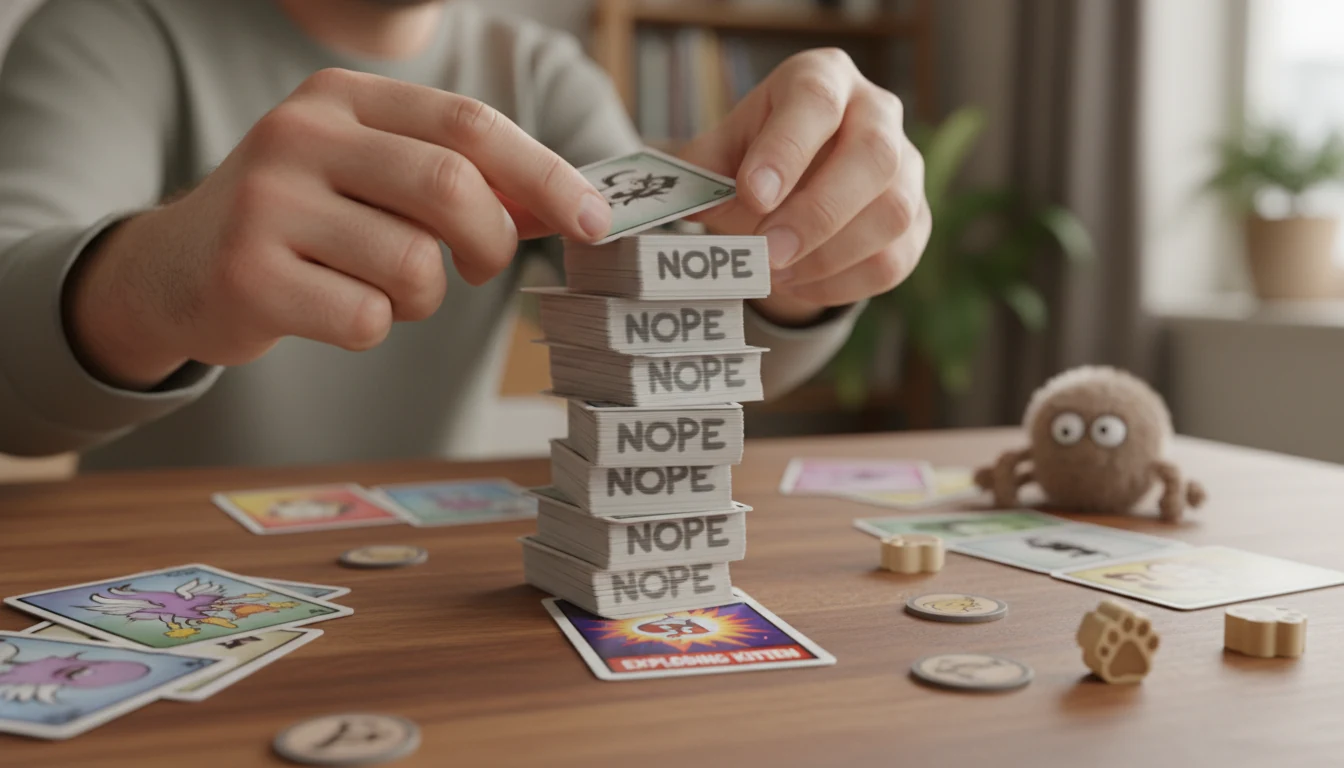
Yes, according to the Exploding Kittens Official Rulebook, you can play a NOPE on another NOPE to create a 'Yup'.

Exploding Kittens Official Rules, [edition not specified], [page not specified]

These rules correspond to the UK edition of Exploding Kittens.

Official Rule Breakdown

Regarding the stacking of NOPE cards, the official rules state that you can play a NOPE on another NOPE to negate it and create a Yup, and so on. A NOPE card can be played at any time before an action has begun, even if it is not your turn, to stop any action except for an Exploding Kitten or a Defuse Card. When a NOPE is played, imagine that any cards beneath that NOPE card never existed, and any cards that have been noped are lost and must be left in the Discard Pile. This mechanism even applies to playing a NOPE on a SPECIAL COMBO.

Step-by-Step

  1. Step 1: An action is initiated by a player.
  2. Step 2: Another player plays a NOPE card to stop that action.
  3. Step 3: A subsequent player may play another NOPE card to negate the previous NOPE, creating a 'Yup'.
  4. Step 4: This chain continues until a player chooses not to play a NOPE or the action is successfully stopped.

Example Play Situation

Alice plays an attack card to force the next player to take two turns. Bob immediately plays a NOPE card to cancel Alice's attack. Charlie then plays another NOPE on Bob's card, turning the negation into a 'Yup'.

Exploding Kittens rules rule situation

Common Misconceptions

  • Thinking a NOPE cannot be played on another NOPE
  • Believing a NOPE can stop an Exploding Kitten
  • Assuming you can only play NOPE cards on your own turn

Quick Reference

You CanYou Cannot
Play a NOPE on another NOPE to create a YupAttempt to use a NOPE to stop an Exploding Kitten
Play a NOPE at any time before an action beginsAttempt to use a NOPE to stop a Defuse Card
Use a NOPE to stop any action except Exploding Kittens or Defuse CardsKeep noped cards in the hand; they must go to the Discard Pile

Frequently Asked Questions

What is the official rule for stacking NOPE cards in Exploding Kittens?
You can play a NOPE on another NOPE to negate it and create a Yup, continuing the chain.
Can I play a NOPE card if it is not my turn?
Yes, you can play a NOPE at any time before an action has begun, regardless of whose turn it is.
Does a NOPE card work against an Exploding Kitten?
No, a NOPE can stop any action except for an Exploding Kitten or a Defuse Card.
What happens to cards that have been noped?
Any cards that have been noped are lost and must be left in the Discard Pile.
Categories
Board Games Card Play Rules

Phase 10 Official Rules: How to Hit and Add Cards

Many players mistakenly believe they can only interact with their own completed phases, but the rules allow for strategic 'hitting' on any phase on the table.

According to the Phase 10 Official Rulebook, you can add cards to any phase already laid down on the table, whether it is your own or another player's.

Phase 10 Official Rules [edition not specified]

Expertise: Board game rules expert. | Verification: Cross-referenced official PDF manual and trusted secondary rule sources. | Purpose: Resolve the #1 confusion regarding hitting other players' phases.
Key Insight: To avoid arguments, ensure everyone agrees on the 'hitting' rule before the first hand begins.

These rules correspond to the US edition of Phase 10.

Official Rule Breakdown

The process of adding cards to existing phases is known as 'Hitting.' According to the official manual, you may make a hit by putting a card directly on a phase already laid down on the table. This card must properly fit with the cards already down, such as adding a '4' to an existing set of '4s' or a '2' to a run of '3, 4, 5, 6.' Crucially, before you can perform a hit, your own Phase must already be laid down. You may hit your own cards, another player's cards, or both, and you may only do so during your turn (Phase 10 Official Rulebook, [page not specified]).

Step-by-Step

  1. Step 1: Successfully lay down your own Phase on the table.
  2. Step 2: On a subsequent turn, draw a card from the draw pile or discard pile.
  3. Step 3: Identify a card in your hand that can be directly added to an existing Phase (yours or an opponent's).
  4. Step 4: Place the card onto the existing Phase to 'hit' it.
  5. Step 5: Discard one card from your hand to end your turn.

Example Play Situation

Alice has already laid down her Phase 1. On her turn, Bob draws a card and sees a '7' in his hand. Since Bob's own Phase is already on the table, he can legally place that '7' onto Alice's existing set of '7s' to make a hit.

Phase 10 rules rule situation

House Rules

[HOUSE RULE] Some groups play with a variation where players can play additional cards on top of other completed phases for strategic advantages, though this is not part of the standard rulebook.

Common Misconceptions

  • Thinking you can only hit your own phases
  • Attempting to hit a phase before your own phase is laid down
  • Adding a card that does not logically fit the existing set or run

Quick Reference

You CanYou Cannot
You can hit your own cardsYou cannot hit a phase if your own phase is not yet laid down
You can hit another player's cardsYou cannot hit a phase if the card does not properly fit the sequence or set
You can add Wild cards to any valid situationYou cannot hit during someone else's turn

Frequently Asked Questions

What is the official rule for hitting in Phase 10?
You can add cards to any laid-down phase if your own phase is already on the table.
Can I add a card to an opponent's phase?
Yes, you can hit another player's cards as long as you have already laid down your own phase.
What happens if my own phase isn't on the table yet?
You are not allowed to make a hit until your own Phase has been successfully laid down.
Do I have to hit my own cards only?
No, you have the option to hit your own cards, another player's cards, or both.
Categories
Board Games Rules & Disputes

Sushi Go! Maki Roll Scoring: Official Rules Guide

Many players mistakenly believe they simply sum the values on Maki cards, but the scoring actually depends on a comparison of total icons among all players.

According to the Sushi Go! Official Rulebook, scoring Maki rolls is based on the total number of sushi roll icons collected by each player.

Sushi Go! Official Rulebook [edition not specified]

These rules correspond to the UK edition of Sushi Go!

Official Rule Breakdown

To score Maki rolls, each player must first add up the total number of sushi roll icons located at the top of all their collected Maki roll cards. A player must possess at least one Maki roll card to be eligible for this specific scoring category. Once totals are calculated, the player with the highest number of icons receives 6 points. If there is a tie for the highest number, the 6 points are split evenly (ignoring any remainder). The player with the second-highest number of icons receives 3 points, and if multiple players tie for second, those 3 points are split evenly (ignoring any remainder).

Step-by-Step

  1. Step 1: Identify all Maki roll cards collected during the round.
  2. Step 2: Count the total number of sushi roll icons at the top of those cards.
  3. Step 3: Compare your total icon count against all other players.
  4. Step 4: Award 6 points to the player(s) with the most icons or split them if tied.
  5. Step 5: Award 3 points to the player(s) with the second most icons or split them if tied.

Example Play Situation

Alice has collected Maki roll cards totaling 5 icons. Bob has 5 icons, and Charlie has 3 icons. Because Alice and Bob are tied for the most, they each receive 3 points (splitting the 6 points and ignoring the remainder). Charlie has the second most icons, so he receives 3 points.

Sushi Go! rules rule situation

Common Misconceptions

  • Thinking you get points for every Maki card regardless of others
  • Forgetting that you must have at least one Maki card to qualify
  • Assuming ties result in no points being awarded

Quick Reference

You CanYou Cannot
Count the icons at the top of the cardsDo not award second place points if there is a tie for first
Split points evenly during tiesDo not count players who have zero Maki roll cards
Ignore remainders when splitting points

Frequently Asked Questions

What is the official rule for scoring Maki rolls in Sushi Go!?
Players count total icons; most icons get 6 points, second most get 3 points.
How do ties work for Maki roll points?
Tied players split the points evenly and any remainder is ignored.
Can I score Maki rolls if I have no Maki cards?
No, you must have at least 1 sushi roll card to be counted in the scoring.
What happens if two people tie for first place?
They split the 6 points evenly, and no second place points are awarded.
Categories
Board Games Card Play Rules

Can You Stack Draw 4 in UNO? Official & House Rules

Many players believe they can pass the penalty to the next person by playing another draw card, but the official rules work differently.

No, according to the Mattel Official Rulebook, stacking Draw cards is expressly forbidden.

UNO Official Rulebook [edition not specified]

Expertise: Board game rules expert. | Verification: Cross-referenced official Mattel rulebook text and secondary rule analysis. | Purpose: Resolve the #1 stacking confusion from player forums.
Key Insight: To avoid arguments, establish whether you are playing with 'Progressive UNO' house rules before the first card is dealt.

These rules correspond to the US edition of UNO.

Official Rule Breakdown

According to the Mattel Official Rulebook, stacking is not a legitimate move in standard UNO play. When a Wild Draw Four card is played, the next player must draw the 4 cards and forfeit their turn. While the official rules state that the next player must draw the 4 cards if the last card played in a round is a Wild Draw Four, they do not provide a mechanism for players to 'stack' these cards to increase the penalty for subsequent players.

Example Play Situation

Alice plays a Wild Draw Four card. Bob, following the official rules, must draw 4 cards and skip his turn. Bob cannot play another Wild Draw Four to pass the penalty to Charlie.

Uno rules rule situation

House Rules

[HOUSE RULE] In the 'Progressive UNO' variant, players may play a Wild Draw Four on top of another Wild Draw Four, causing the next player to draw 8 cards. This can continue as long as players have consecutive cards in their hands.

Common Misconceptions

  • Stacking Draw 2 cards on top of each other
  • Using a Wild Draw Four to increase the penalty to 8 cards
  • Passing the draw penalty to the next player via stacking

Quick Reference

You CanYou Cannot
Draw the required number of cards when a Draw card is playedStack a Draw Two on a Draw Two
Forfeit your turn when a Draw card is played on youStack a Wild Draw Four on a Wild Draw Four

Frequently Asked Questions

What is the official rule for stacking in UNO?
No, official rules state that stacking is not a legitimate move.
Can I play a Wild Draw Four on top of another Wild Draw Four?
No, you must draw the 4 cards and skip your turn instead.
Is it allowed to stack Draw Two cards to make someone draw 4?
No, this is only allowed if you are playing with specific House Rules.
What happens if I try to stack cards during a regular game?
The next player should simply draw the cards indicated by the first card played.