Categories
Board Games Card Play Rules

Phase 10 Official Rules: Can You Go Out Without a Phase?

Many players mistakenly believe they can win a hand by simply emptying their hand, regardless of whether they have completed their current Phase.

No, according to the Phase 10 Official Rulebook, you cannot 'go out' to win a hand unless you have first successfully laid down your required Phase.

Phase 10 Official Rules [edition not specified]

Expertise: Board game rules expert. | Verification: Cross-referenced official Phase 10 manual text. | Purpose: Resolve the common misconception regarding the sequence of laying a Phase versus going out.
Key Insight: To avoid arguments, ensure players clearly lay their Phase face-up on the table before they start hitting or discarding.

These rules correspond to the US edition of Phase 10.

Official Rule Breakdown

According to the Phase 10 Official Rulebook, the process of finishing a hand is strictly sequential. First, a player must be able to make a Phase with the cards in their hand and lay that Phase down, face-up, on the table. Only after laying down a Phase can a player attempt to 'go out' as soon as possible. To go out, a player must get rid of all remaining cards by either discarding them or by 'hitting' (placing a card onto an existing Phase already on the table). If a player empties their hand without having laid down their Phase, they have not completed the required objective for that hand.

Step-by-Step

  1. Step 1: Collect the necessary cards in your hand to meet the requirements of your current Phase.
  2. Step 2: Lay the Phase down face-up on the table before discarding any cards.
  3. Step 3: Once the Phase is laid down, attempt to get rid of all remaining cards in your hand.
  4. Step 4: Complete the 'go out' process by discarding cards or hitting existing Phases on the table.

Example Play Situation

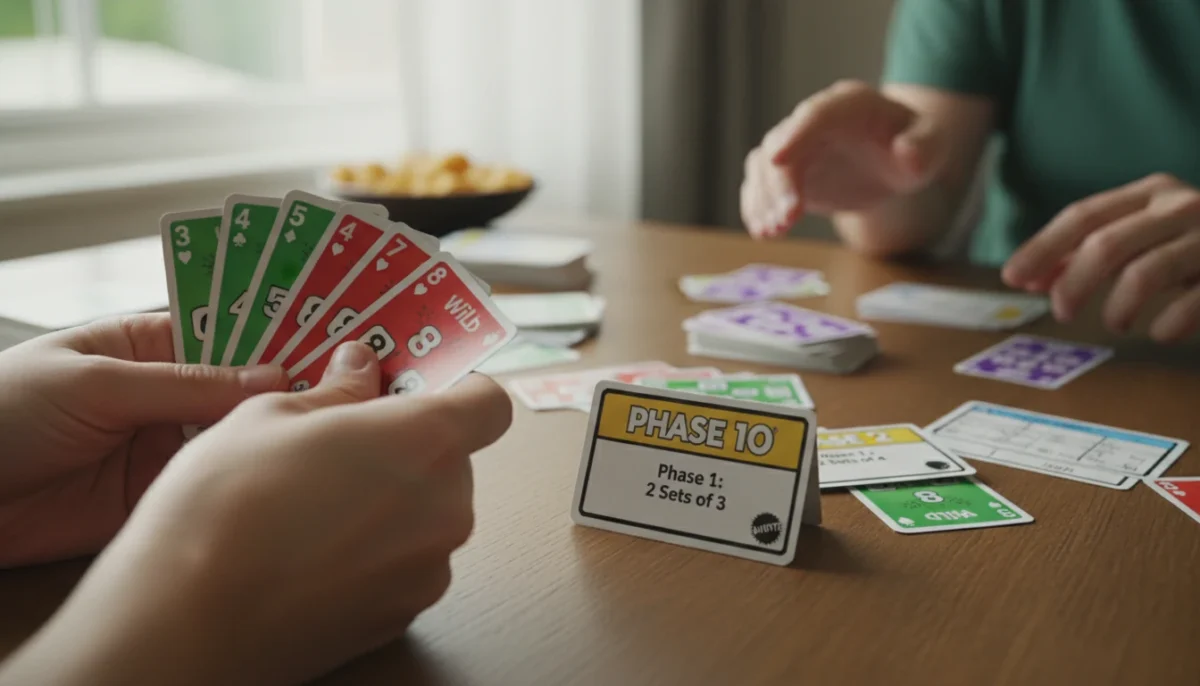
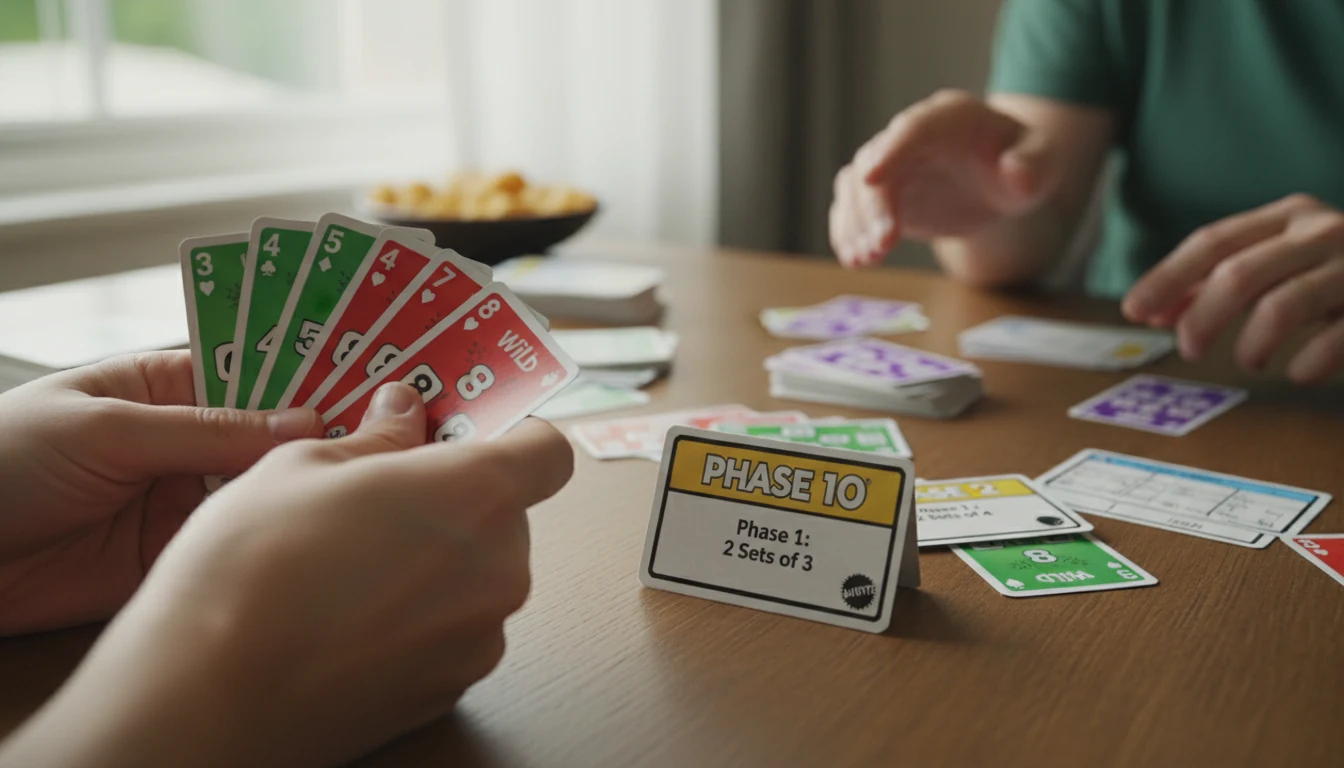
Alice has completed Phase 1 by laying down two sets of three. She then uses her remaining cards to hit existing Phases on the table. Once Alice has no cards left in her hand, she has successfully 'gone out.' Bob, however, discards all his cards but forgot to lay down his Phase first; therefore, Bob has not gone out and must try for the same Phase again in the next hand.
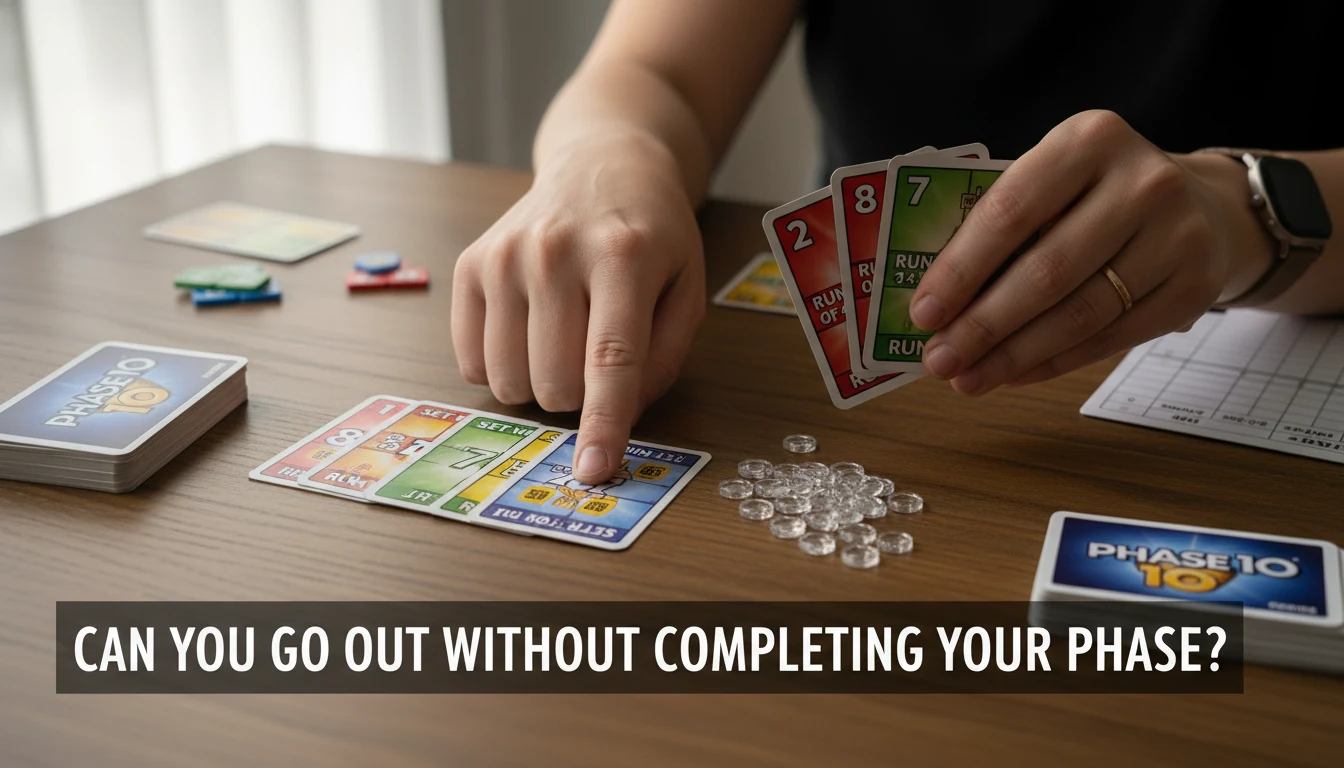
Phase 10 rules rule situation

Common Misconceptions

  • Thinking you can win the hand just by having zero cards left.
  • Believing you can go out before laying down your Phase.
  • Assuming you can use 'Skip' cards to complete a Phase.

Quick Reference

You CanYou Cannot
Lay down your Phase face-up before discardingDo not attempt to go out before laying down your Phase
Hit existing Phases to get rid of leftover cardsDo not use Skip cards to make a Phase
Use Wild cards to complete sets or runsDo not lay down more than one Phase per hand

Frequently Asked Questions

What is the official rule for going out in Phase 10?
You must lay down your Phase first, then discard or hit existing Phases to empty your hand.
Can I discard all my cards and win if I haven't made my Phase?
No, you must successfully lay down your Phase before you can attempt to go out.
Is it allowed to hit another player's Phase to go out?
Yes, you may hit your own cards, another player's cards, or both to get rid of your hand.
What happens if I empty my hand but didn't lay down my Phase?
You fail to complete the Phase and must try for that same Phase again in the next hand.
Categories
Board Games Strategy Games

Catan: Cities & Knights Knight Pre-Roll Official Rules

Many players wonder if they can use a knight to manipulate the robber before the dice are cast, assuming standard Catan rules apply.

Yes, according to the Catan: Cities & Knights Official Rulebook, you can use a knight to chase away the robber before rolling the dice if you use the Knight-Errant Variant.

Catan Cities & Knights Official Rules, [edition not specified]

Expertise: Board game rules expert. | Verification: Cross-referenced official Catan: Cities & Knights rulebook text. | Purpose: Resolve the #1 confusion regarding pre-roll knight usage in the Cities & Knights expansion.
Key Insight: To avoid arguments, ensure all players agree to use the Knight-Errant Variant before the first turn begins.

These rules correspond to the US edition of Catan: Cities & Knights.

Official Rule Breakdown

Regarding the ability to play a knight before rolling, the official rules include a specific 'Knight-Errant Variant.' This variant allows a player to use one of their active knights to chase away the robber before rolling the dice on their turn. Once this action is taken, the knight becomes deactivated. This mechanism functions similarly to playing a knight card before rolling in the base Catan game.

Step-by-Step

  1. Step 1: Declare the intention to use the Knight-Errant Variant.
  2. Step 2: Select one of your active knights to chase away the robber.
  3. Step 3: Deactivate the chosen knight.
  4. Step 4: Proceed to roll the dice for your turn.

Example Play Situation

Alice has an active knight on the board. Before she rolls the dice, she uses the Knight-Errant Variant to chase the robber away with her knight. The knight is then deactivated, and Alice proceeds to roll her dice.

Catan rules rule situation

Common Misconceptions

  • Thinking the knight can be used to chase the robber during a standard game without the variant enabled
  • Assuming the knight remains active after being used to chase the robber
  • Confusing the Knight-Errant Variant with the standard turn sequence

Quick Reference

You CanYou Cannot
Use an active knight to chase the robber before rollingUse a knight to chase the robber if you are not using the Knight-Errant Variant
Deactivate the knight after using it in the Knight-Errant VariantKeep the knight active after using it for this specific variant action

Frequently Asked Questions

What is the official rule for playing a knight before rolling in Catan: Cities & Knights?
Under the Knight-Errant Variant, you can use an active knight to chase the robber before rolling.
Can I use a knight to move the robber before I roll the dice?
Yes, provided you are playing with the Knight-Errant Variant rule enabled.
What happens to my knight if I use it to chase the robber before rolling?
The knight becomes deactivated immediately after the action.
Is it allowed to use a knight to chase the robber during a normal turn without the variant?
No, this specific pre-roll action is part of the Knight-Errant Variant rule.
Categories
Board Games Card Play Rules

Exploding Kittens Attack Card Rules: Official Rules Guide

Many players mistakenly believe that an Attack card always forces a player to take two turns, but the rule can be interrupted by other cards.

According to the Exploding Kittens Official Rulebook, an Attack card can be negated by a Nope card, which prevents the forced double turn from occurring.

Exploding Kittens Official Rules, [edition not specified], [page not specified]

These rules correspond to the UK edition of Exploding Kittens.

Official Rule Breakdown

Regarding the interaction between Attack cards and Nope cards, the rules specify that a Nope card can be played at any time before an action has begun, even if it is not your turn. If a player attempts to play an Attack card to force the next player to take two turns, another player may play a Nope card to negate that action. Once a Nope is played, the action is cancelled, and the original player's turn continues. The rules state that any cards that have been noped are lost and must be left in the Discard Pile.

Step-by-Step

  1. Step 1: A player plays an Attack card to force the next player to take two turns.
  2. Step 2: Another player plays a Nope card before the action is completed.
  3. Step 3: The Attack action is negated and the Nope card is placed in the Discard Pile.
  4. Step 4: The player who played the Attack card continues their turn normally.

Example Play Situation

Alice plays an Attack card to force Bob to take two turns. Before the effect takes hold, Bob plays a Nope card to cancel the attack. Alice's turn continues, and she must now decide whether to play more cards or draw to end her turn.

Exploding Kittens rules rule situation

Common Misconceptions

  • Thinking an Attack card is an unstoppable action
  • Believing you can only play a Nope on your own turn
  • Assuming an Attack card automatically ends the current player's turn

Quick Reference

You CanYou Cannot
You can play a Nope on another Nope to create a YupYou cannot play a Nope on an Exploding Kitten
You can play a Nope on a Special ComboYou cannot play a Nope on a Defuse Card
You can play a Nope at any time before an action begins

Frequently Asked Questions

What is the official rule for Attack cards in Exploding Kittens?
An Attack card forces the next player to take two turns unless negated by a Nope.
Can I use a Nope card to stop an Attack?
Yes, playing a Nope card cancels the action before it takes effect.
When is the best time to play a Nope card?
You can play it at any time before an action has officially begun.
What happens to cards that are noped?
Those cards are lost and must be placed in the Discard Pile.
Categories
Board Games Card Play Rules

UNO Wild Card Official Rules and House Rule Guide

Many players mistakenly believe that special action cards can be played on top of one another to create chain reactions, but the official rules for Wild cards are quite specific.

Yes, according to the Mattel Official Rulebook, you may play a Wild card on your turn even if you have another playable card in your hand.

UNO Official Rules, [edition not specified]

Expertise: Board game rules expert and content writer. | Verification: Cross-referenced official rulebook text from provided evidence chunks. | Purpose: Resolve the #1 confusion regarding Wild card play priority and stacking.
Key Insight: To avoid arguments, establish whether you are playing with 'Progressive' house rules for Draw cards before the first round starts.

These rules correspond to the UK edition of UNO.

Official Rule Breakdown

Regarding the use of Wild cards, the official rules state that when you play this card, you get to choose the colour that continues play, including any colour that was in play before the Wild card was laid down. Furthermore, the rules explicitly clarify that a player may play a Wild card on their turn even if they possess another playable card in their hand. This distinguishes the Wild card from other action cards that must match the colour or number of the discard pile.

Example Play Situation

Alice has a Red 7 and a Wild card. She decides to play her Wild card instead of the Red 7. She chooses Blue as the colour, and it is now Bob's turn to play a Blue card.

Uno rules rule situation

House Rules

[HOUSE RULE] In the 'Progressive UNO' variant, players may play consecutive Draw Two or Wild Draw Four cards to increase the penalty for the next player, potentially causing them to draw 4, 8, or more cards depending on the number of consecutive cards played.

Common Misconceptions

  • Thinking you must play a matching colour/number card before using a Wild card
  • Believing Wild cards can only be played if you have no other moves
  • Assuming Wild cards can be 'stacked' like Draw Two cards in official rules

Quick Reference

You CanYou Cannot
Play a Wild card even if you have other playable cardsAssume you must match the discard pile colour to play a Wild card
Choose any colour to continue play after a Wild card is played

Frequently Asked Questions

What is the official rule for playing a Wild card in UNO?
You can play it any time and choose the colour that continues play.
Can I play a Wild card if I have a matching colour card in my hand?
Yes, you may play a Wild card even if you have another playable card.
Is it allowed to change the colour to one that was just played?
Yes, you can choose any colour, including the one previously in play.
What happens if a Wild card is turned up at the start of the game?
The person to the left of the dealer chooses the colour to continue play.
Categories
Board Games Card Play Rules

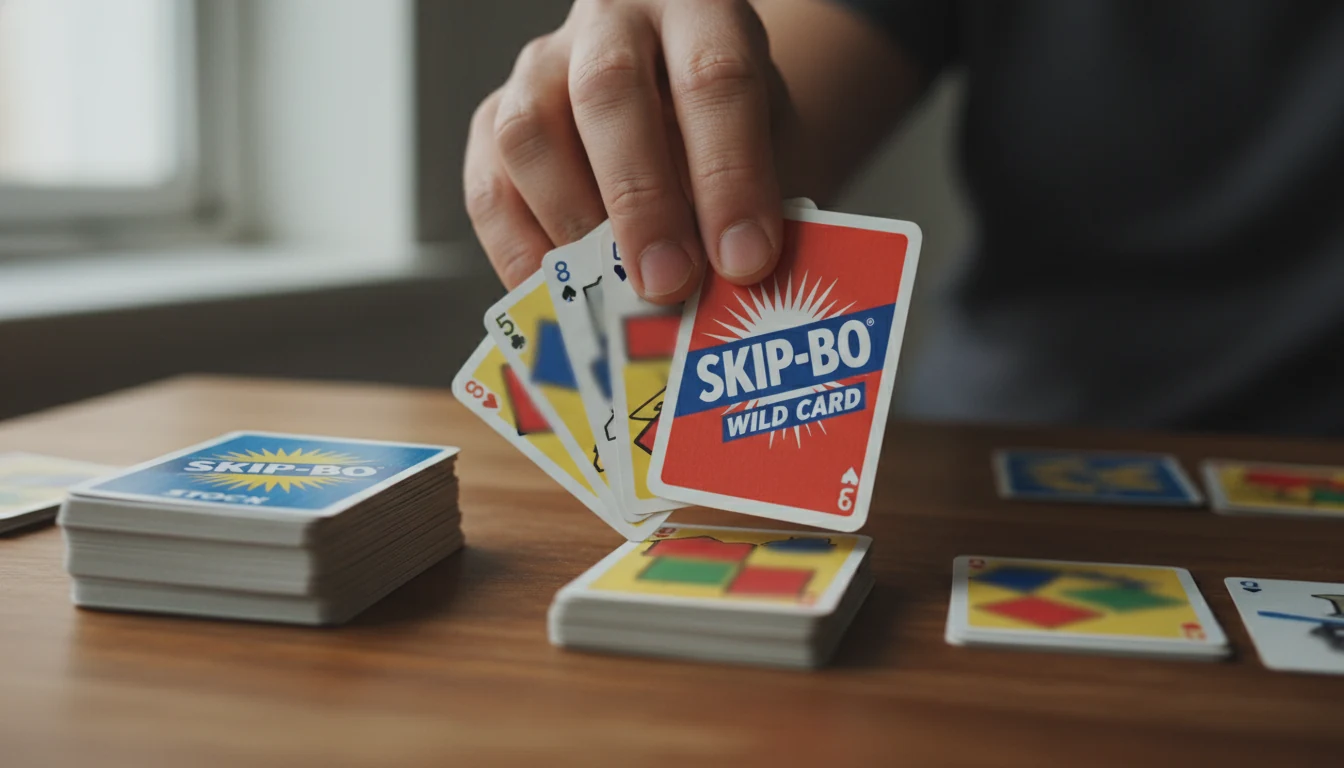
Skip-Bo Official Rules: Running Out of Stock Pile Cards

Many players mistakenly believe the game ends immediately when a single player's stock pile is empty, but the rules account for different play modes.

According to the Mattel Official Rulebook, the game ends when the STOCK piles of a partnership are finished in partnership play, or when a single player uses up all cards in their STOCK pile.

Skip-Bo Official Rulebook, [edition not specified]

Expertise: Board game rules expert. | Verification: Cross-referenced official rulebook text regarding partnership play and STOCK pile completion. | Purpose: Resolve the #1 confusion regarding game end triggers in Skip-Bo.
Key Insight: To avoid arguments, clarify before the first deal if you are playing individual or partnership mode.

These rules correspond to the UK edition of Skip-Bo.

Official Rule Breakdown

In standard play, the objective is to be the first player to play all the cards from your individual STOCK pile. However, in partnership play, the rules specify that the game is over when both STOCK piles of one of the partnerships are finished. During these turns, both partners can continue to play from their remaining DISCARD or STOCK piles even if one of the STOCK piles is finished (Skip-Bo Official Rulebook, [page not specified]).

Example Play Situation

Alice and Bob are playing in a partnership. Alice finishes her STOCK pile, but Bob still has three cards left. Because they are a partnership, they continue their turn, allowing Bob to play his remaining cards from his DISCARD or STOCK piles to complete the partnership's goal.

Skip-Bo rules rule situation

Common Misconceptions

  • The game ends the moment any player's stock pile is empty
  • Partners stop playing if one partner runs out of cards
  • You cannot use discard piles once your stock pile is empty

Quick Reference

You CanYou Cannot
Continue playing from DISCARD piles in partnership modeStop the game if only one partner in a team is finished
Use SKIP-BO cards as wild cards to build pilesForget to draw cards to bring your hand back to 5
Draw 5 cards to start your turn

Frequently Asked Questions

What is the official rule for running out of stock pile cards in Skip-Bo?
The game ends when the STOCK piles of a partnership are finished, or when a single player empties theirs.
Can I still play cards if my partner's stock pile is already empty?
Yes, both partners can continue playing from their remaining DISCARD or STOCK piles.
Does the game end immediately when one person has no cards left?
No, if playing in partnerships, the game ends when both partners' piles are finished.
What happens if I am playing the short version with 10 cards?
All other rules remain the same, including how the game ends.
Categories
Board Games Card Play Rules

UNO Wild Draw 4 Challenge: Official and House Rules

Many players are unsure whether they can challenge a Wild Draw 4 play or what the penalty is if the challenge fails.

Yes, according to the Mattel Official Rulebook, you may challenge a player if you suspect they played a Wild Draw 4 card illegally.

UNO Official Rules, 2008 Mattel, Inc. [page not specified]

Expertise: Board game rules expert. | Verification: Cross-referenced official 2008 Mattel, Inc. rulebook content. | Purpose: Resolve the #1 source of disputes regarding Wild Draw 4 challenges.
Key Insight: To avoid arguments, ensure everyone agrees on the 'matching colour' definition before the first Wild Draw 4 is played.

These rules correspond to the UK edition of UNO.

Official Rule Breakdown

According to the Mattel Official Rulebook, a Wild Draw 4 card may be played only if the player does not have a card in their hand that matches the colour of the card previously played. If you suspect a player has played this card illegally, you may challenge them. The challenged player must show their hand to the challenger. If the challenged player is found guilty, they must draw the 4 cards. However, if the challenged player is innocent, the challenger must draw the 4 cards plus an additional 2 cards, for a total of 6 cards.

Step-by-Step

  1. Step 1: Suspect a player played a Wild Draw 4 card without a matching colour in their hand.
  2. Step 2: Declare a challenge to the player.
  3. Step 3: The challenged player shows their entire hand to the challenger.
  4. Step 4: Determine guilt; if guilty, the player draws 4 cards. If innocent, the challenger draws 6 cards.

Example Play Situation

Alice plays a Wild Draw 4 card. Bob suspects Alice has a matching red card and issues a challenge. Alice shows her hand and reveals she has no red cards, making her innocent. Bob must now draw 6 cards.

Uno rules rule situation

House Rules

[HOUSE RULE] In the Progressive UNO® variant, players can play consecutive Wild Draw Four cards; the next player in the sequence draws 8 cards, and the last person to play the card calls the colour.

Common Misconceptions

  • Challenging is allowed even if you don't have a matching colour yourself.
  • The penalty for an innocent player is only 4 cards.
  • You can play a Wild Draw 4 even if you have a matching number or word card of a different colour.

Quick Reference

You CanYou Cannot
You can challenge a Wild Draw 4 playYou cannot challenge if the player actually lacks a matching colour
You can play a Wild Draw 4 if you lack a matching colourYou cannot play a Wild Draw 4 if you have a matching colour in your hand
You can play a Wild Draw 4 even if you have a matching number/word of a different colour

Frequently Asked Questions

What is the official rule for challenging a Wild Draw 4 in UNO?
If the player is guilty, they draw 4; if innocent, the challenger draws 6 cards.
Can I challenge a Wild Draw 4 if I have a matching colour in my hand?
Yes, any player can initiate a challenge if they suspect an illegal play.
What if the player is innocent after a challenge?
The challenger must draw the 4 cards plus 2 additional cards (6 total).
Is it allowed to play a Wild Draw 4 if I have a matching number of a different colour?
Yes, you may play it as long as you don't have a matching colour.
Categories
Board Games Rules & Disputes

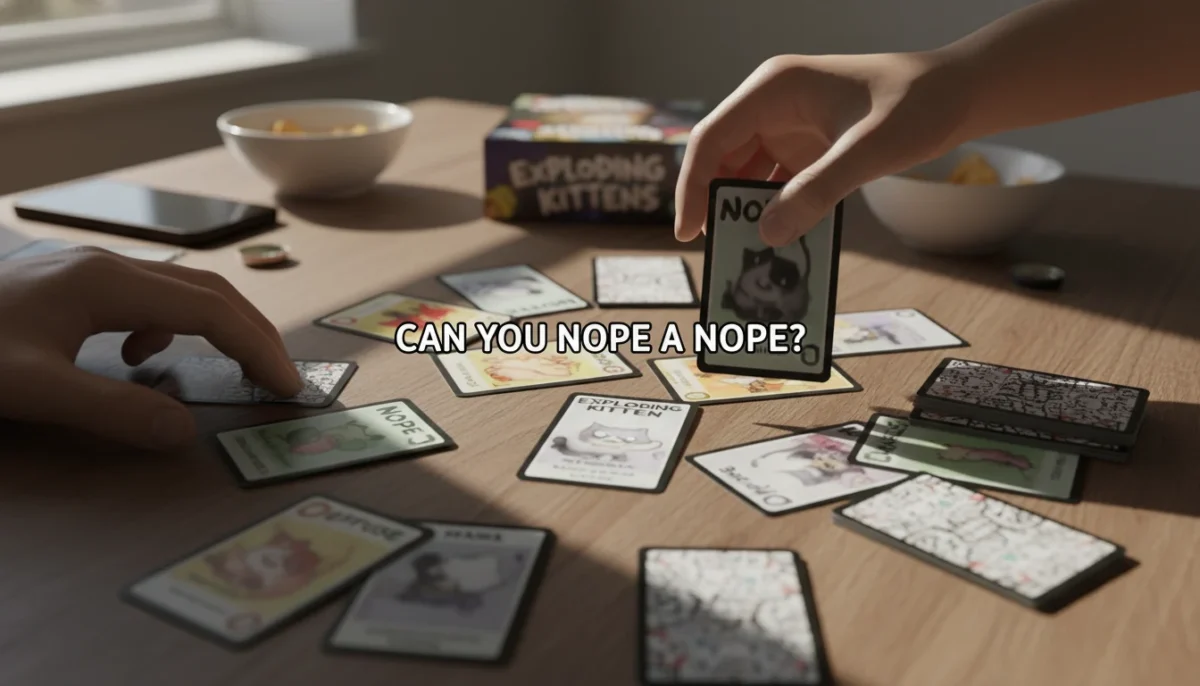
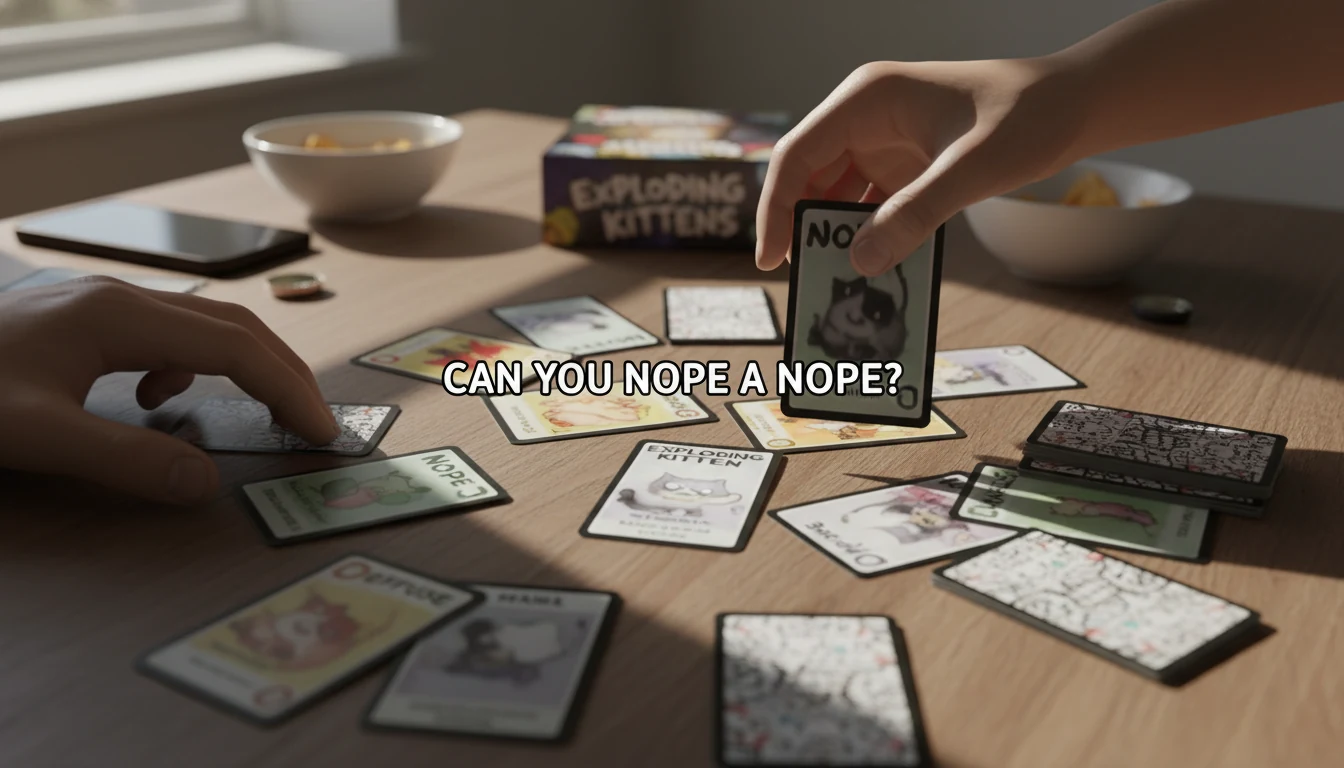
Exploding Kittens Official Rules: Can You Nope a Nope?

Many players wonder if the chain of negation can continue indefinitely or if a Nope card is a one-time use only.

Yes, according to the Exploding Kittens Official Rulebook, you can play a Nope on another Nope.

Exploding Kittens-rules.pdf [page not specified]

These rules correspond to the US edition of Exploding Kittens.

Official Rule Breakdown

Regarding the ability to play a Nope on a Nope, the official rules state that you can play a Nope on another Nope to negate it and create a Yup, and so on. A Nope card can be played at any time before an action has begun, even if it is not your turn, to stop any action except for an Exploding Kitten or a Defuse Card. Any cards that have been noped are lost and must be left in the Discard Pile.

Example Play Situation

Alice plays a Skip card to end her turn. Bob immediately plays a Nope card to stop her action. Alice then plays her own Nope card to negate Bob's Nope, effectively turning it into a Yup.

Exploding Kittens rules rule situation

Common Misconceptions

  • Thinking a Nope card can stop an Exploding Kitten
  • Thinking a Nope card can stop a Defuse Card
  • Believing you can only play a Nope on your own turn

Quick Reference

You CanYou Cannot
Play a Nope on another Nope to create a YupUse a Nope to stop an Exploding Kitten
Play a Nope at any time before an action beginsUse a Nope to stop a Defuse Card
Use a Nope to stop a Special Combo

Frequently Asked Questions

What is the official rule for playing a Nope in Exploding Kittens?
You can play a Nope on another Nope to negate it and create a Yup.
Can I use a Nope card if it is not my turn?
Yes, you can play a Nope at any time before an action has begun.
Does a Nope card work on an Exploding Kitten?
No, you cannot use a Nope to stop an Exploding Kitten or a Defuse Card.
What happens to cards after they are noped?
Any cards that have been noped are lost and must be placed in the Discard Pile.
Categories
Board Games Strategy Games

Catan Longest Road Counting Rules: Official Guide

Many players mistakenly believe that branching roads or settlements can be included when calculating the total length of their longest road.

According to the Catan Official Rulebook, the Longest Road is a continuous road of at least five individual segments that is not interrupted by other players' pieces.

Catan Official Rules 2020, [page not specified]

Expertise: Board game rules expert. | Verification: Cross-referenced official 2020 Catan manual and official FAQ. | Purpose: Resolve the #1 confusion regarding road segment counting and branching.
Key Insight: To avoid arguments, establish that only the single longest branch counts before the first road is built.

These rules correspond to the US edition of Catan.

Official Rule Breakdown

To determine the Longest Road, you must count the individual road pieces in a single continuous line. According to the Catan Almanac, if your road network branches, you may only count the single longest branch for the purposes of the Longest Road. The road must consist of at least five segments and must not be interrupted by game pieces belonging to other players, such as a settlement. If a player builds a road of the same length as the current holder, the card remains with the current owner; however, if a player builds a strictly longer road, they immediately take the card and the 2 victory points (creating a 4-point swing).

Example Play Situation

Alice has a continuous road of 6 segments and holds the Longest Road card. Bob builds a continuous road of 7 segments, which is longer than Alice's. Bob immediately takes the Longest Road card from Alice and gains 2 victory points.

Catan rules rule situation

Common Misconceptions

  • Counting all branches of a road network
  • Including settlements as part of the road length
  • Thinking a tie results in a card swap

Quick Reference

You CanYou Cannot
Count only the single longest branch if your road network branchesDo not count branch roads that deviate from the main line
Ensure the road has at least 5 segmentsDo not include settlements in your segment count
Check that no opponent settlements interrupt the path

Frequently Asked Questions

What is the official rule for counting the longest road in Catan?
Count the single longest continuous branch of at least 5 segments that is not interrupted by others.
Can I have a circular road for the Longest Road?
Yes, as long as the segments establish an uninterrupted connection between intersections.
What happens if my road is broken by an opponent's settlement?
Your road is split into two parts, and you may lose the Longest Road card if you no longer have the longest.
Does my own settlement interrupt my continuous road?
No, your own settlements do not interrupt your continuous road.
Categories
Board Games FAQ & Clarifications

Exploding Kittens Stealing Rules: Official Card Combo Guide

Many players mistakenly believe that only Cat Cards can be used to steal, but the official rules allow for broader combinations.

According to the Exploding Kittens Official Rulebook, you can steal a random card from another player by playing matching pairs.

Exploding Kittens Official Rules, [edition not specified], [page not specified]

These rules correspond to the US edition of Exploding Kittens.

Official Rule Breakdown

To steal a card, you must play matching pairs. While Cat Cards (cards with no instructions) must be played as matching pairs to steal a random card from another player, the rules also specify that playing matching pairs of any cards with the same title (such as a pair of Skip Cards or a pair of Shuffle Cards) functions as a special combo. These pairs allow you to pick another player and steal a random card from their hand. According to the manual, these cards are powerless on their own but become effective when collected as a pair.

Step-by-Step

  1. Step 1: Collect two cards that share the same title (such as two Cat Cards or two Skip Cards).
  2. Step 2: Play the matching pair as a single action.
  3. Step 3: Select any other player at the table.
  4. Step 4: Steal one random card from that player's hand.

Example Play Situation

Alice plays a pair of Cat Cards. She chooses Bob as her target and steals a random card from his hand. Bob then draws a card to end his turn.

Exploding Kittens rules rule situation

Common Misconceptions

  • Thinking only Cat Cards can be used for stealing
  • Believing you can choose which specific card to steal from a player's hand
  • Thinking you must play cards one by one instead of as a pair

Quick Reference

You CanYou Cannot
You can play matching pairs of Cat Cards to steal a cardYou cannot use a single card to steal
You can use pairs of other titled cards like Skip Cards to steal a cardYou cannot choose a specific card from a player's hand; it must be random
You can play as many cards as you like before drawing to end your turn

Frequently Asked Questions

What is the official rule for stealing cards in Exploding Kittens?
Play matching pairs of cards to steal a random card from another player's hand.
Can I use two Skip Cards to steal a card?
Yes, matching pairs of any cards with the same title can be used as a special combo.
Do Cat Cards have instructions for stealing?
No, they have no instructions but must be played in matching pairs to steal a card.
How do I end my turn in Exploding Kittens?
You end your turn by drawing a card from the top of the Draw Pile.
Categories
Board Games Card Play Rules

Phase 10 Official Rules: Adding Cards to Laid Down Sets

Many players wonder if they can add extra cards to a Phase they have already laid down to make it larger or more complete.

According to the Mattel Official Rulebook, you may lay down more than the minimum requirements of a Phase, but only if the additional cards can be directly added to the cards already in the Phase.

Phase 10 Official Rules, Mattel Edition, [page not specified]

Expertise: Board game rules expert and content writer. | Verification: Cross-referenced official Mattel rulebook text regarding Phase laying mechanics. | Purpose: Resolve confusion regarding the legality of adding extra cards to completed Phases.
Key Insight: To avoid arguments, ensure players agree that 'extending' means the card must fit the existing sequence or number group.

These rules correspond to the UK edition of Phase 10.

Official Rule Breakdown

Regarding the ability to add cards to a Phase, the official rules state that while you must meet the minimum requirements for a Phase, you are permitted to lay down more than the minimum if the additional cards can be directly added to the cards already in the Phase. For example, if you lay down three '5s' and three '7s' to complete Phase 1, and you also hold two additional '5s' in your hand, you may immediately lay those down with the existing '5s' during the same turn. However, you cannot add cards that do not fit the existing structure; for instance, if you have completed Phase 1, you cannot add a set of '10s' because Phase 1 specifically requires exactly two sets, and adding a third set would violate the Phase's structure.

Step-by-Step

  1. Step 1: Form the minimum required combinations (sets or runs) for your current Phase in your hand.
  2. Step 2: Lay the Phase down face-up on the table before discarding.
  3. Step 3: Check if any remaining cards in your hand can be directly added to the sets or runs already laid down.
  4. Step 4: Lay down those additional cards in the same turn if they extend the existing combinations.

Example Play Situation

Alice is working on Phase 1. She lays down three '5s' and three '7s' to meet the requirement of two sets of 3. Because she also has two extra '5s' in her hand, she immediately lays them down to extend her first set. Bob, however, has a set of '10s' but cannot add them because they do not extend the '5s' or '7s' already on the table.

Phase 10 rules rule situation

House Rules

[HOUSE RULE] Some groups play a variation where 'hitting' (discarding cards onto a completed Phase) is mandatory to end a hand, though official rules focus on the Phase completion and the subsequent discard.

Common Misconceptions

  • Thinking you can add a third set to a Phase that only requires two sets.
  • Believing you can add cards to a Phase in a later hand once it is already on the table.
  • Attempting to add cards that don't match the existing numbers or sequences.

Quick Reference

You CanYou Cannot
You can add extra cards if they extend an existing setYou cannot add cards that create a new, unrequired combination
You can add extra cards if they extend an existing runYou cannot add cards that do not directly connect to the laid-down cards
You can lay down more than the minimum requirements in one turn

Frequently Asked Questions

What is the official rule for adding cards to laid down sets in Phase 10?
You can add extra cards only if they directly extend the sets or runs already in the Phase.
Can I add a third set of cards to my Phase 1 if I have them?
No, you can only add cards that directly extend the existing sets or runs required for that Phase.
What happens if I have extra cards that don't fit my Phase?
You must discard those cards to end your turn instead of laying them down.
Do I have to lay down the whole Phase at once?
Yes, you must have the entire Phase in your hand before laying it down face-up.